

5-Minute Grounding Meditation For Anxiety Relief

Originally published January 2022 | Refreshed June 2026
Welcome in. If you’re looking for a practice to help you exhale, shake off the stress of anxiety, and feel supported in a way that touches more than just your mind, you’re in the right place.
When stress, anxiety and overwhelm overload your system it’s common for the mind to reach for something, anything, to make it stop. You try to push through, think your way out of it, convince yourself you’re fine…find something that will ‘fix’ it.
But anxiety isn’t just in your mind. It lives in your nervous system. It lives in the quiet places the body holds, in the shallow breath that keeps your system on high alert.
As a licensed holistic therapist with over 10 years of experience, there’s one thing that’s clear to me: You can't think your way out of what your body is communicating.
The invitation here is to slow down, stop trying to fix yourself and tend to what your mind, body, heart and spirit are trying to tell you.
This is what a grounding meditation offers: An invitation to pause, to notice, to meet yourself before trying to change anything at all. This is how change happens.
The medicine is turning toward what's actually here, with breath, with body, with curiosity. The practice is learning how to turn down the volume in your head so you can tune into the wisdom of your heart.
I made this 5-minute guided grounding meditation as a soft place to land. A practice that helps you anchor into yourself, find a way to exhale, and let yourself be supported.
What is a Grounding Meditation?
Grounding meditation is a guided practice that helps you bring your attention and energy in and down, anchoring you in your body and nervous system to soothe anxiety, quiet racing thoughts, and access a sense of safety in yourself.
If anxiety is "up and out" energy, ungrounded, untethered, looking for the exit, grounding is the "in and down" practice that brings you home. It's the literal ground for everything else on the healing journey.
To be grounded and anchored in yourself is to be able to access a felt sense of safety. Not the cognitive kind, where you just tell yourself you're fine and try to believe it. The deep, body-level safety that lives in your bones, your breath, your belly. The kind of safety your nervous system has to feel before any other healing can really happen.
In this grounding practice, you'll learn to cultivate kindness and compassion for yourself while tuning into the wisdom of your body through breath and focused attention. Sound complicated? It's not. I'll be guiding you the whole time. All you have to do is sit, get curious, and listen.
This is a practice for when your mind is in overdrive, when anxiety is interrupting your day, when your breath is high and shallow, or when you simply can't find your way back to your heart.
Why Grounding Works for Anxiety
What actually happens in your body when you do a grounding meditation? Why does sitting and breathing for five minutes shift your energy faster than trying to think your way out of anxiety?
The short answer: A grounding meditation works for anxiety because it speaks the language of your nervous system: Breath. Body. Attention.
The same practices wisdom traditions offer, now backed by science and clinical research that's finally catching up.
Anxiety lives in the nervous system, not just in your mind
For a long time, the medical model treated anxiety as a thinking problem: Change your thoughts, change your life. And while insight and reframing have their place, they don’t repattern the deeper places in your system where anxiety takes root.
Anxiety is autonomic. It’s alive in the nervous system before it becomes a story in your mind. Research (Chalmers 2014) consistently shows that people with anxiety disorders have measurably reduced heart rate variability, the biological marker for how flexible and regulated your nervous system is. What that means: anxiety is happening in your body before it's happening in your thoughts. That's why you can know intellectually that you're safe and still feel like a hundred-pound gorilla is sitting on your chest.
This is how we go beyond managing symptoms. Yes, we want to change our minds. But often the fastest way to change our minds is to change our physiology, our biology, our body. We can't separate the head from the heart, or the head from the body. It's all one nervous system.
Breath is the medicine
So if anxiety lives in the nervous system, how do we actually shift it?
The body has a built-in regulator: the vagus nerve. It runs from your brainstem through your heart, your lungs, your belly, all the way down into the core of your body. And the most direct way to engage it is through your breath.
When you breathe slowly, especially when your exhale is longer than your inhale, you send a signal of safety up through that nerve. Your heart rate slows. Your nervous system softens. Your body remembers it doesn't have to brace against everything.
Studies of slow breathing (Laborde 2022) show measurable shifts in heart rate variability after just one session. Five to ten minutes of conscious breathing is enough to start changing your physiology.
The mindset shift is this: Breath is the medicine. Breath changes our heart rate. Breath changes how anxiety moves through the nervous system.
Grounding is not just a spiritual ideal anymore. It's evidence-based and science-backed. It's the 'in and down' energy that metabolizes anxiety and anchors you back into your body.
“Breath is the medicine. Breath changes our heart rate. Breath changes how anxiety moves through the nervous system. ”
Where neuroscience meets mysticism
The breath practices modern science is now measuring aren't new.
Yoga and meditation traditions have been teaching this for generations: Somatic awareness. Breathwork. Energy work. Cultivating intuition. These aren’t just wellness trends. They are nervous system technologies, a roadmap for the healing journey, taught across the world in every culture and tradition we know of, that the West is now accepting and translating through science, psychology and medicine.
What scientists call interoception, the brain's capacity to read signals from inside your own body, contemplative traditions have always called inner wisdom. It’s the capacity to listen, to turn inward, to trust what the body already knows.
Neuroscience is starting to map territory mystics and wisdom traditions have honored for thousands of years.
A 2023 clinical trial (Hoge 2023) found that an 8-week mindfulness-based stress reduction course produced anxiety reductions equivalent to a leading anti-anxiety medication. Translation: the practice your grandmother called prayer, your therapist calls somatic awareness, and your yoga teacher calls presence is real medicine, by every measurable standard.
The clinical and the spiritual aren't separate paths anymore. They're the same wisdom, different translation.
You can only go as deep as your nervous system feels safe
And underneath all of this: safety.
Neuroscientist Stephen Porges, founder of polyvagal theory, coined the term neuroception to describe how your body scans for safety and threat below the level of conscious awareness. Your nervous system is constantly asking, before your thinking mind even gets involved: am I safe here?
“Neuroscience is starting to map territory mystics and wisdom traditions have honored for thousands of years. ”
The answer determines what level of information you can access in your head, heart, body and soul. When your nervous system reads "safe," you can connect, you can reflect, you can feel the deeper layers of your own experience without leaving your body. When it reads "danger," everything closes. Even stillness feels unsafe. The practices that are designed to help can actually push you further into a stress response.
What to do? Practice.
Carve out 5 minutes to sit, to orient, to drop into the body and offer it a way out of the stress cycle. This is why I created the 5-minute grounding meditation below. Deciding to practice a grounding meditation is no small thing. It's the foundation for all healing work. When you can access safety in your body, even just a tiny bit more at a time, you can go deeper into the shadowy bits, the grief, the pain that your body has been holding for a lifetime. Before you can hear the wisdom of your heart, your body has to feel safe enough to let you in.
The breath is how you start.
Grounding Meditation Benefits
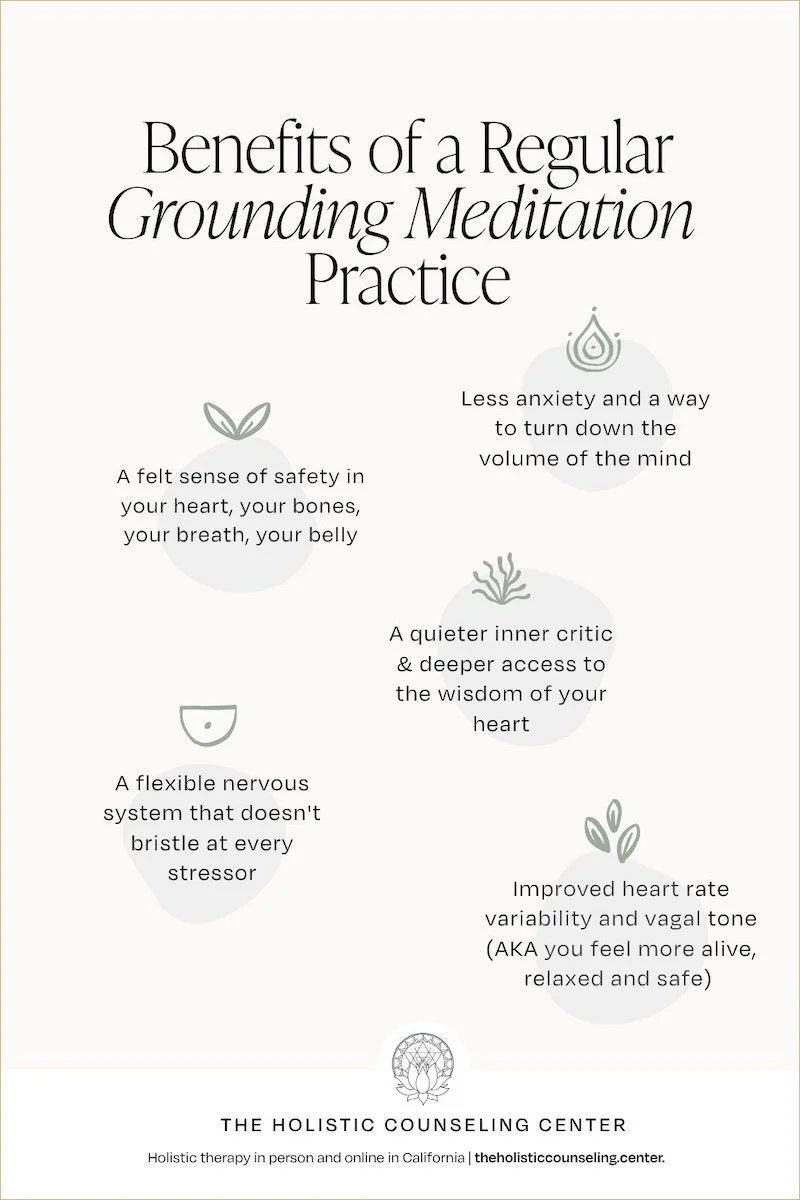
The benefits of a regular grounding meditation practice are real, felt, and measurable. With consistent practice, you can experience:
A felt sense of safety in your heart, your bones, your breath, your belly
Less anxiety and a way to turn down the volume of the mind
A flexible nervous system that doesn't bristle at every stressor
A quieter inner critic
Improved heart rate variability and vagal tone (AKA you feel more alive, relaxed and safe)
Deeper access to the wisdom of your heart
Who Should Practice Grounding Meditation?
A grounding meditation practice is for anyone struggling with anxiety, overwhelm, or burnout who wants a simple, accessible way to soothe the nervous system and drop into a more peaceful state.
Whether you're new to meditation or have been practicing for years, whether you're spinning right now or just feel a familiar unease in your gut, this 5-minute practice was designed to help you shift gears quickly.
Most therapeutic practices offer a CBT or DBT inspired technique commonly known as the 5-4-3-2-1 method, the one where you name five things you can see, four you can touch, three you can hear, and so on. This technique is popular because it gets your prefrontal cortex back online when anxiety has taken over.
This grounding meditation helps you anchor into the body, not just quiet your mind. Because everything I know about healing points back to alignment, integration and learning to access the wisdom of the mind, body, heart and spirit. Getting your head back on board is just the beginning, not the destination.
That deeper anchoring is what this meditation offers. Not a sensory inventory that temporarily pulls you out of your mind with distraction, but a somatic practice that brings you down into the breath, the belly, the body. The threads we're weaving together here include mindfulness, presence, somatic awareness, energy work, and access to the wisdom of the body, all awakening together.
This grounding meditation is for you if:
Your mind is stuck in overdrive and you can't find the off switch
Anxiety is hijacking your day and the obvious tools aren't helping
You're carrying tension in your chest, your shoulders, your jaw, your belly
You've tried meditation before and felt like you were "doing it wrong"
You want a practice short enough that you’ll actually do it, deep enough to actually shift something
And a gentle reminder: One minute a day of conscious breathing adds up to more self-care over time than zero minutes a day. Five minutes adds up faster. The point of practice isn't perfection or even a permanent erasure of anxiety. The point is showing up for yourself, committing to yourself, caring for yourself…one breath at a time, and building the capacity for safety, connection and care in your own body.
But...I Can't Meditate
If you've ever said "I can't meditate," pause. Everyone can.
Meditation gets a bad rap because people think it means making your mind quiet or stopping all your thoughts. But the brain's job is to think. If you have a mind, it will be thinking. Trying to force stillness is the fastest way to make yourself more anxious.
So if you've tried meditation and felt like you were doing it wrong, you weren't. You were doing what every human mind does.
At the heart of meditation is the invitation to love yourself deeply. To turn toward yourself with curiosity, care, presence and openness. To connect with your Self, your deep inner wisdom and radiant heart, one breath at a time. Not to silence your mind, but to soften your relationship with it.
Here's the only test that matters: after you practice, check in. Do you notice even 1% more ease in your body? 1% less tension in your chest? 1% more space between you and your thoughts? That's the practice working. Because real change happens 1% at a time, breath by breath, moment by moment, not all at once.
If you are human and breathing, you can meditate. Promise.
How to Practice a Grounding Meditation
I made this quick and effective 5 minute guided meditation to help you reduce symptoms of anxiety and overwhelm so you can experience more ease and calm in your mind, heart and body, starting today.
The practice itself is simple. You don't need a special cushion, an empty house, or a quiet mind. You just need five minutes and a willingness to slow down. Here's a gentle walkthrough of what to do before, during, and after.
Before You Begin
Find a comfortable position. Take a moment to check in on what your body actually needs today. Maybe it’s sitting cross-legged on the floor, sitting in a chair with your feet flat, or lying down with a blanket over you. If sitting feels best, see if you can lengthen your spine and soften your shoulders without straining. If lying down feels best, let yourself feel the support underneath you.
Choose a place with as little interruption as possible. A quiet room is ideal, but not required. You can practice in a parked car between meetings or with your kids at the end of a hard day. It’s all part of the practice.
Set an intention to show up and practice. Nothing to fix, force or figure out. There's no right way to do this. The practice is literally just showing up.
During the Practice
All you have to do is press play. I'll guide you through the rest. You'll be invited to notice your breath, to soften your belly, to let your body sink and settle into the support beneath you.
If your mind wanders, just notice it. That's your mind doing what minds do. Each time you notice your mind thinking, gently bring your attention back to the breath. The noticing is part of the practice.
You might feel more relaxed immediately. Or you might feel more tension surfacing than you expected. Some days this meditation will feel like a big exhale. Other days it might feel activating. Both are okay. Whatever shows up, receive it as a loving message from your body, your heart, your Highest Self.
If sitting in stillness feels too overwhelming, open your eyes, take a sip of water, move gently. Give yourself permission to pause.
After the Practice
When the meditation ends, take a moment before you rush back into your day. Feel the surface underneath you. Notice your breath. See if anything has shifted, even 1%.
Some days the impact is obvious: a quieter mind, a lighter chest, a body that feels like it can finally exhale. Other days the shift will be more subtle or feel like nothing has happened. Making time for yourself is the practice.
If something came up during the meditation that wants more attention, journaling can help. A few sentences about what you noticed, or what your body was communicating. No analysis or figuring out required, just witnessing.
Then, when you're ready, gently transition back to your life, taking whatever arrived with you into your next conversation, your next task, your next breath.
Ready to practice?
Go ahead and find a spot....
Now take a deep breath in and out...
Press play and enjoy the practice!
When to Practice a Grounding Meditation
The beauty of a 5-minute grounding meditation is that you can drop into it almost any moment of your day. Here are some great times to do this practice:
First thing in the morning to connect with yourself before the chaos of the day begins
Between meetings or tasks to reset your nervous system instead of carrying tension and stress in your body
Before a hard conversation to ground yourself in your mind, body and heart before you dive in
After a therapy session to give your system space to integrate what came up
In transition moments between work and home, before walking in the door
In the evening to shift from doing into being and prepare your body for rest
Anytime your nervous system needs a reset when life feels full and you want to come back to yourself
The more often you practice, the more your nervous system starts to recognize this as a place that feels good, that feels safe. Over time, even thinking about practicing becomes a small way to come back home to yourself.
Ready to put this into practice? Grab my free guide: 5 Holistic Practices for Soothing Anxiety →
drop your email below to Download the guide
When Grounding Isn't Enough For Anxiety
A grounding meditation is a great daily practice for supporting burnout, stress and anxiety. But oftentimes, it’s not enough to repattern the nervous system and rewire outdated patterns of being in the world.
If you find yourself struggling with anxiety, if it's interfering with your relationships, your purpose, your work, sleep, or your sense of self, it might be time for the deeper work of therapy.
At the end of the day you can't think your way out of anxiety. And you can't meditate your way out of anxiety either. There are so many tools that can help: meditation, medication, mindfulness, therapy, exercise…just to name a few.
There's no single tool that works for everyone struggling with anxiety. We're complex, layered, beautifully unique beings, and our healing asks for multiple threads woven together.
Sometimes sitting in stillness with your breath, body and heart can activate deep discomfort. The thing that's supposed to relax you starts to feel overwhelming. If this happens, that's important information. It often points to material that's ready for more support than a self-guided practice can hold, and it deserves the care of a trained therapist.
If you're not sure what the next step is, you don't have to figure it out alone. Keep reading to learn more about how we can help.
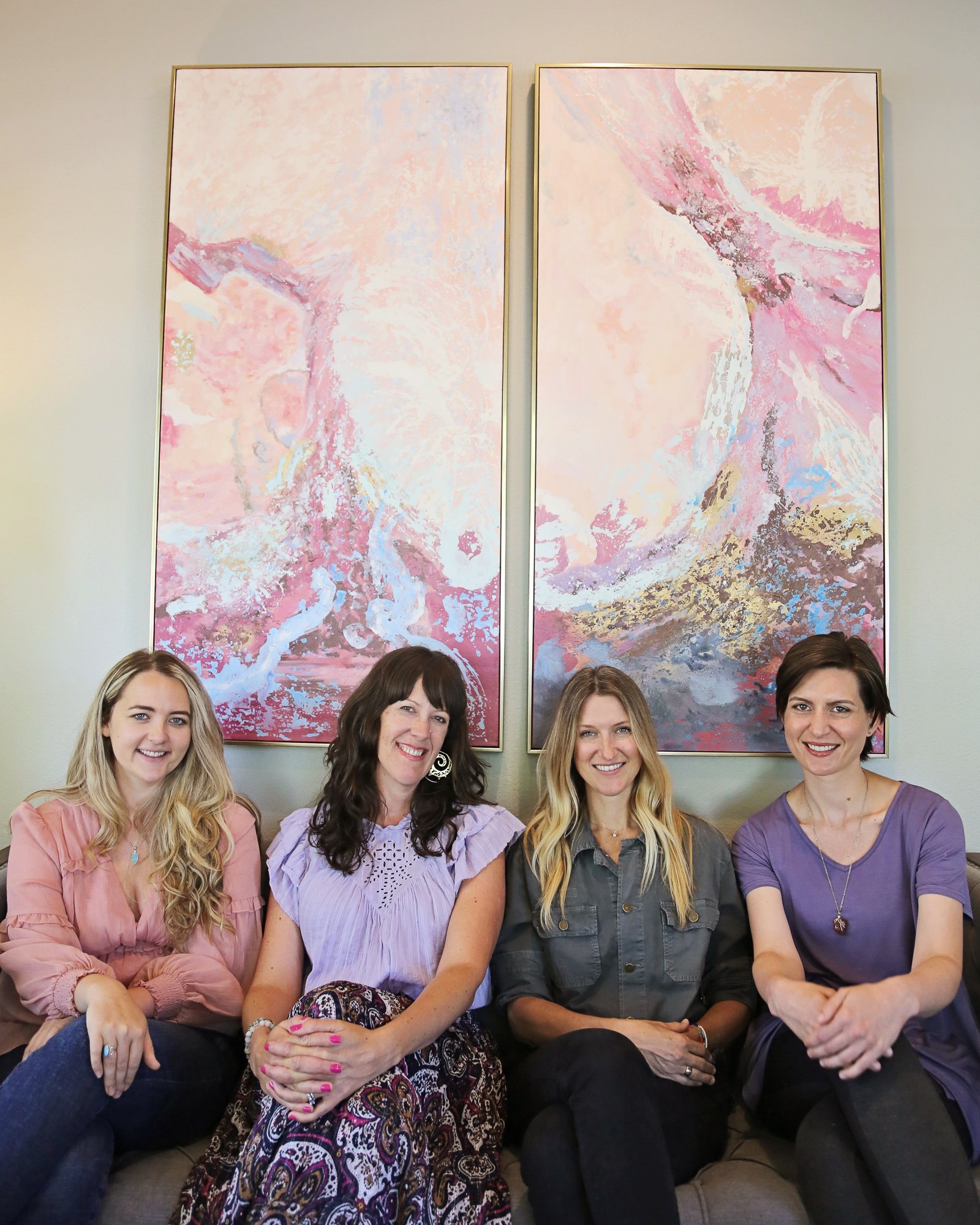
Therapy for Anxiety at The Holistic Counseling Center
At The Holistic Counseling Center, we don't just see anxiety as a problem to fix, or something to get rid of. We treat it as a signal, an invitation to listen to what your mind, body, heart and spirit are trying to tell you. Our approach to therapy isn't just treating the symptoms, but unearthing the root.
Our therapeutic work is built on the integration of five threads: mindfulness, groundedness, somatic awareness, spiritual depth, and psychological insight. Each one alone is powerful. Woven together, they become medicine.
We weave evidence-based psychotherapy with somatic therapy, polyvagal-informed nervous system work, Internal Family Systems (IFS), mindfulness-based practice, and transpersonal depth work. Our approach draws on the lineage of Peter Levine, Stephen Porges, Richard Schwartz, and the contemplative traditions of Sri Vidya, Kundalini Yoga, Reiki, and Mindfulness, to name just a few.
In practice, this looks like tending to the nervous system, reconnecting with your spiritual heart, and understanding how the mind-body connection impacts everything in your life.
If you're ready to go deeper on your healing journey, we'd love to support you.
We're currently accepting new clients for anxiety therapy and holistic counseling online throughout California and in-person at our offices in El Dorado Hills, San Anselmo and San Francisco, with evening and weekend appointments available.
Taking the next step is simple:
Schedule a free consultation call. We'll explore what's bringing you to therapy and answer your questions.
Get matched with a holistic therapist. You can also speak directly with your recommended therapist before booking a session.
Begin your healing journey. Have your first session and start finding the relief and clarity you've been looking for.
Takeaway
Seeking therapy doesn’t mean you're broken. It means you’re human, struggling, and brave enough to reach out for support.
If you recognized yourself in any of these signs, trust that knowing. You don't need to wait until things get worse. And you don't need a "good enough" reason.
Your wellbeing is reason enough. So let yourself be supported.
Book a Free Consultation Call →
Additional Resources
References
Chalmers, J. A., Quintana, D. S., Abbott, M. J-A., & Kemp, A. H. (2014). Anxiety disorders are associated with reduced heart rate variability: A meta-analysis. Frontiers in Psychiatry, 5, 80. https://doi.org/10.3389/fpsyt.2014.00080
Hoge, E. A., Bui, E., Mete, M., Dutton, M. A., Baker, A. W., & Simon, N. M. (2023). Mindfulness-based stress reduction vs escitalopram for the treatment of adults with anxiety disorders: A randomized clinical trial. JAMA Psychiatry, 80(1), 13-21. https://doi.org/10.1001/jamapsychiatry.2022.3679
Laborde, S., Allen, M. S., Borges, U., Dosseville, F., Hosang, T. J., Iskra, M., Mosley, E., Salvotti, C., Spolverato, L., Zammit, N., & Javelle, F. (2022). Effects of voluntary slow breathing on heart rate and heart rate variability: A systematic review and a meta-analysis. Neuroscience & Biobehavioral Reviews, 138, 104711. https://doi.org/10.1016/j.neubiorev.2022.104711

About the Author
Kim Burris, LMFT is a licensed holistic psychotherapist, founder of The Holistic Counseling Center, and author of ‘The First 90 Days After Birth.’
Her work has been featured in Vogue, Bustle, and the Daily Om.
Kim honors the mind-body-spirit connection and offers evidence-based psychotherapy with a heart-centered approach that helps people find relief from anxiety and self-sabotage so they can live life with more joy, freedom, and ease.
Kim and her team are trained in Brainspotting, somatic therapies, and trauma-informed care. They currently offer holistic counseling and therapy in San Francisco, San Anselmo, El Dorado Hills, and online.
Book a free consultation call to get started.
Grounding Meditation Transcript
Hey guys, it's Kim. Today I want to offer you a guided meditation for grounding. So go ahead and find a comfortable seat. Ideally, you're sitting up tall with your spine straight. You can prop yourself up on a pillow, sit cross-legged, lay down if you need some extra care today. Just finding a comfortable space.
And just allowing yourself to arrive here in this moment. And just feeling the muscles in your belly. See if you can just wiggle around a little bit and let yourself soften.
And from this space, see if you can just feel as you breathe deeper, your space that you're taking up expanding a little bit.
And just begin to ever so gently deepen your breath.
It might feel good for you to count your breath today. So noticing your inhale is happening one, two, three, four. Exhaling one, two, three, four. Just allowing your breath to move in through the nose, down into the belly, and back out through the nose.
And just start to feel the circuitry of your breath. The nourishment of the breath as it rides in through the nose into the body, and the releasing of what you no longer need on the exhale. Belly softening, expanding into your seat.
Continuing to count the breath or watch the breath, being with yourself as you breathe right now.
And I want you to begin to notice how the breath fills up your belly cavity. Again, softening the belly muscles, softening your pelvic floor, feeling yourself expand.
And with each breath, moving that energy all the way down into your belly, feeling yourself supported on whatever surface you're sitting on.
Breathing in and breathing out, connecting to your belly, anchoring in.
And as you feel this circular circuitry of breath moving in and out of your body, just noticing, allowing, inviting your body to drop in deeper, become heavier. Sink into your seat. Sink into your space. Sink into your body.
Let yourself be held right where you're at. Being aware of any feelings that might be arising as you create space for yourself.
This might feel calming, and this might feel activating. Just seeing if you can welcome and turn towards whatever might be arising. As you breathe in, down into your belly, feeling yourself anchor into your space, anchor into your body.
If it's helpful, you can imagine an anchor resting in your body with each inhale, just feeling the weight of that anchor settling into your whole being. With each breath, inhaling a heaviness and a fullness, taking up space.
And let's just take a few more breaths here in this space together. Just allowing yourself to be wherever you may be right now.
Breathing in, breathing out. Breathing in, breathing out. Anchoring down, down, down into your body, into the earth, into your seat.
And just taking a moment here to notice what it feels like in your body being where you're at right now.
And if you have more time and space to continue sitting here, please go ahead and do so. If you know you need to get up and out after our few moments together, you can gently blink your eyes open if they're closed. And just bringing your whole self back into the room. And knowing you have the capacity to anchor into yourself with your breath throughout the day, throughout your days.
I hope that practice was helpful for you guys. Thanks for letting me be with you. For those of you that don't know me, my name is Kim Burris. I'm a holistic psychotherapist in California. If you have any questions about this practice go ahead and feel free to contact me, shoot me a message, or leave a comment below.
All right. Take care everybody. Bye.

Recent Blog Posts:


Anxiety isn't all in your head. A licensed holistic therapist on healing anxiety at the root: your nervous system, what helps, and what therapy can do.