How to Heal Burnout: A Holistic Therapist’s Guide
If you’re exhausted in a way that no amount of sleep, rest, or resetting can reach, wondering how to recover from burnout when you can’t even find a minute to slow down… you’re in the right place.
Maybe you’re still doing all the things. Showing up for work, for family, for everyone who needs you. Responding to every email, text, and social media DM like your life depends on it. Moving so fast you collapse at the end of the day and hope that one night of sleep will miraculously recharge your system.
And somewhere along the way, you stopped being able to feel your Self, your life, your joy. You’re numb, overwhelmed, and a little bit frozen, all at the same time. Feeling like you’re constantly behind, and somehow never doing enough. And in the rare quiet moment when you pause and look within, you can’t seem to find yourself anymore.
I’m Kim Burris, a licensed psychotherapist, founder of The Holistic Counseling Center, and I’ve spent over a decade helping people heal from anxiety, overwhelm, and burnout. I also know what it’s like to create an intentional life that suddenly feels like an avalanche you can’t escape from. And I’ve learned how to reset, rewire, and rewrite the story.
However it’s showing up for you right now, I want you to know: burnout is real, what you’re feeling makes sense, and there is a way through. And the answer is not another protocol, or one more thing for your to-do list. It’s softer, simpler, and much more accessible than you think.
Let’s take a breath and begin.
Ready for the TLDR? You can download our free Healing Burnout Guide here, and come back for the deep dive when you’re ready.
What Is Burnout?
Let's start with the popular clinical definition first, and then look at how this is incomplete and get into the deeper meaning.
The World Health Organization defines burnout as a syndrome that results from chronic stress that hasn't been successfully managed. It names three dimensions: exhaustion, a growing cynicism or mental distance from your life and work, and a growing sense that you can’t do anything as well as you used to.
BURNOUT — Burnout is chronic stress your body can no longer metabolize. It tends to show up in three ways: exhaustion that rest just can’t reach, apathy about your own life and things you used to love, and a creeping doubt in your own competence.
Technically, the WHO classifies burnout as an occupational phenomenon, something that happens at work. But if you're a mother, an artist, a person holding down a household and a career and everyone's emotional weather all at once, or a modern-day human, you already know the truth: chronic stress isn’t just about work.
More and more people are showing up in my office who feel like they are fraying at the seams, holding it all together…they feel like something is wrong, even though they can’t quite put their finger on what that is. Every day feels like a fire alarm going off that they just can’t turn off. If that’s you, stay with me. It might be burnout.
Here’s one thing the textbook definition misses about burnout:
Burnout doesn’t always mean you’re depleted or running on empty.
I used to think burnout meant you were stuck in a life you hated, a job that was soul-sucking, or a life that lacked meaning or purpose. And then it happened to me, while living a life I had built on purpose and genuinely loved. My first thought was, "How could I be burned out? I love everything happening in my life right now."
It opened me up to a new dimension of burnout that isn’t always talked about and can quietly eat away at your confidence, conviction, and capacity for happiness: burnout can also be a nervous system that is maxed out and way too full.
Think about it this way, your system takes in so much every single day: the media, the tasks, the ideas, the expectations, the beautiful plans you said yes to. And when there's too much coming in and not enough moving out, your body simply can't metabolize it all. Like a wonderful meal that doesn't end, at some point your body stops asking for more and starts begging you to stop.
For some of you, burnout is a clear collapse, a lack of life force energy, and a fog similar to depression that settles in. For others, it shows up more subtly: a slow disconnection from finding joy in the simple gifts of everyday living, less capacity to feel good in your body, a voice that gets louder and louder each day that you need life to stop, slow down, or just find a pause button. And running through all of it, that keyed-up, on-edge feeling that you’re never able to be done, no matter how much you do.
Whether you’re coming here today too full or running on empty, the pain is the same: a nervous system that can't take in one more thing, and a you that's getting harder and harder to find.
So how do you know if you’re actually burned out? Let’s get into it.
The Signs of Burnout
Burnout doesn’t arrive all at once. It builds slowly over time, which is exactly why so many people don’t recognize it in themselves until they’re in deep. If you’ve ever caught yourself googling “Am I burned out?”, see how many of these feel familiar:
You’re exhausted and nothing seems to fix it. A full night of sleep, a day off, a weekend away, and your body still wakes up restless and heavy.
You feel disconnected from or apathetic about your own life. You’re doing all the things, but you’ve lost touch with the feelings underneath it all.
You’re constantly behind. No matter how much you do, there’s a quiet panicked voice inside that says it’s never enough.
You swing between wired and shut down, sometimes both in the same hour.
Things you used to love now feel like to-do items on an endless list.
You’re more irritable, more anxious, more on edge than you’d like to admit.
Your body is speaking up: headaches, tension in your neck and jaw, digestive trouble, catching every cold that comes through the house.
Stillness feels unreachable or unbearable. On the rare occasion you do stop or try to slow down, you don’t know what to do with yourself.
No matter what you do, rest feels impossible.
If you found yourself nodding along at this list, you’re probably in the burnout zone. Before you panic, just know that recognizing where you’re at is the first step on the path to healing burnout. Your body, mind, heart, and spirit have probably been trying to get your attention for a while, and this is the moment you’re actually able to listen. Phew.
For those of you feeling heavy, disoriented, or hopeless and wondering if it’s burnout or depression, let’s take a look.
Burnout vs. Depression: What’s the Difference?
It’s a fair question, because from the inside they can feel similar. Burnout is typically connected to specific roles and responsibilities in life that are tangible and actionable, and burnout symptoms tend to improve with lifestyle changes such as learning how to reset the nervous system, and reducing the demands on your life and schedule.
Depression affects all areas of your life, and rolls in like a great storm cloud. It’s less obviously tied to a particular job, domain of life, or specific responsibility in your life. It’s sometimes related to brain chemistry changes from past trauma, adverse childhood experiences, gut health, or genetics (just to name a few). It doesn’t go away just by taking a break, changing your job, or doing less.
The two can also overlap, so please don’t try to diagnose yourself from a blog post. If you’re not sure which one you’re dealing with, that’s exactly the kind of question our burnout therapists can help you sort through. Either way, whatever you’re struggling with is real, and it deserves attention, compassion, and care.
For those of you sitting with burnout, and wondering why rest alone doesn’t fix it, we need to talk about your nervous system.
Ready to get to the root of your burnout?
Our holistic therapists can help you rewire your nervous system,
rebuild your energy, and find your way back to yourself.
Book a Free Consultation Call
Burnout and the Nervous System: Why You Can’t Just Push Through
If rest isn’t the antidote to burnout, then what is?
Here’s what I know about healing burnout: dealing with the source of your stress and dealing with the stress that lives in your body are two different things.
Emily and Amelia Nagoski, in their book Burnout: The Secret to Unlocking the Stress Cycle, name this distinction beautifully. The stressor is the thing out there: the deadline, the diagnosis, the toddler, the inbox. The stress is the physiological cascade it sets off inside your body. And here’s the part that really matters if you’re struggling with burnout: dealing with the stressor does not discharge the stress.
Yes, you can solve the problem, send the email, finish the day, even board the plane for vacation, but your body is still carrying the chemical reaction of that stress. And until you actually metabolize it, it will continue to cycle through your head, heart, and body. Aka the stress doesn’t just go away when you close your laptop.
This is what burnout is underneath it all: a stress cycle that never completes.
Cycle after cycle stays open, and the frenetic energy continues to build. Researchers call this allostatic load, the cumulative wear on a system that no longer gets to return to baseline. Translation? Your body has been tracking every little thing, and it’s holding on until you deal with it. (Don’t panic yet. We’re going to get into how to deal with this below).
This is also why you can’t just keep pushing through like you used to, and why willpower and mindset tricks don’t help anymore. Once your nervous system is at capacity and something triggers you, you no longer have the capacity to just think your way out of it. You can’t just tell it to stop and move on. Coming back from burnout is a process, a thawing, a gradual rewiring of your entire life.
And before you dive into self-blame and criticism, please know: burnout is not a you problem.
Burnout is a symptom of an overwhelmed society, and a culture of speed, consumerism, endless consumption, and social comparison. It’s a symptom of a material world that values and prioritizes to-do lists and achievements and productivity, over relationships, connection, ease, and consciousness.
In case you needed this reminder: Your brain was not built to make thousands of decisions a day. Your nervous system was not built to process an endless scroll of posts, headlines, and hundreds of texts, all before lunch. This is not what we’re designed for. Your body is beautiful, adaptive, wired for joy, connection, and bliss, and always learning.
The question isn’t how do we go back to some slower pace of life before computers and iPhones ruled the world… The question is how do you support the system you have, in the world you actually live in. Right here, right now.
We’ll get there. First, two quick stops: why burnout found you in the first place (it’s probably not the reason you think), and where you are in the process.
What Causes Burnout?
The oversimplified answer is too much work, and not enough rest, play, and connection. And while it’s factually true, it doesn’t sufficiently explain the deeper pattern, which is why you keep going long past the point when your body is asking you to stop.
“Burnout is a symptom of an overwhelmed society, and a culture of speed, consumerism, endless consumption, and social comparison. It’s a symptom of a material world that values and prioritizes to-do lists and achievements and productivity, over relationships, connection, ease, and consciousness.”
Here’s what I see in my psychotherapy practice: burnout usually finds people through their strengths. You’re the capable one, the responsible one. You over-give, over-function, and over-deliver, often because somewhere along the way you learned that rest has to be earned, and that love and belonging come to those who hold it all together. Perfectionism, people-pleasing, and old attachment patterns are programs, most of them written in childhood, still running in the background of a very full life.
There’s a cultural layer too. The Nagoskis call it Human Giver Syndrome, a term they built on the work of philosopher Kate Manne: the unspoken rule that certain people, disproportionately women, are expected to give everything, their time, energy, attention, and care, while staying pleasant, positive, and endlessly available. If you were raised to be the giver, stopping doesn’t just feel hard, it feels like the most dangerous move you could make.
And for so many of the wonderful people we work with here at The Holistic Counseling Center, burnout arrives under the guise of high-functioning anxiety. You’re super capable, competent, successful, and driven, keeping it all together in the midst of chaos, overwhelm, and constant doing. You might not even recognize the symptoms your body is throwing your way, because you keep carrying on. That drive, endless productivity, and always being on top of things can steadily destroy your nervous system.
Burnout is often what happens when that high-performing engine has been running hot for years, and finally starts to misfire.
One more layer to fold in here that’s important to name, especially in the healing journey wellness world: even healing can become a place to over-function. A humbling lesson I learned recently is that you can do all the right things, a dedicated meditation practice, breathwork, yoga, supplements, and still burn out.
Because when all that doing is driven by a story of not-enoughness, more doing can’t fill the gap. The self-care industry will happily hand you another practice, course, or retreat. What it cannot hand you is the thing your system is actually asking for. (I can’t wait to share this with you.)
Burnout happens when a responsive nervous system meets patterns and pressures that never get to close the loop. And that is better news than it sounds, because patterns can be rewired, and loops can be closed.
So if you’re beating yourself up for being weak, lazy, or unmotivated, when you are actually just burned out on this wild ride called life, please pause, take a breath, and keep reading. Because before we get to the medicine, it helps to know where you are on the map.
The 5 Stages of Burnout
Clinicians and researchers commonly describe five stages of burnout, a map first sketched by psychologists Herbert Freudenberger and Gail North, whose original twelve phases of burnout are often simplified into the five below.
Before we dive in, I want to say this: this is a map, not a staircase. You can live in one stage for years, move backward and forward, or land in different stages in different parts of your life. The map matters because knowing where you are changes what kind of care you need.
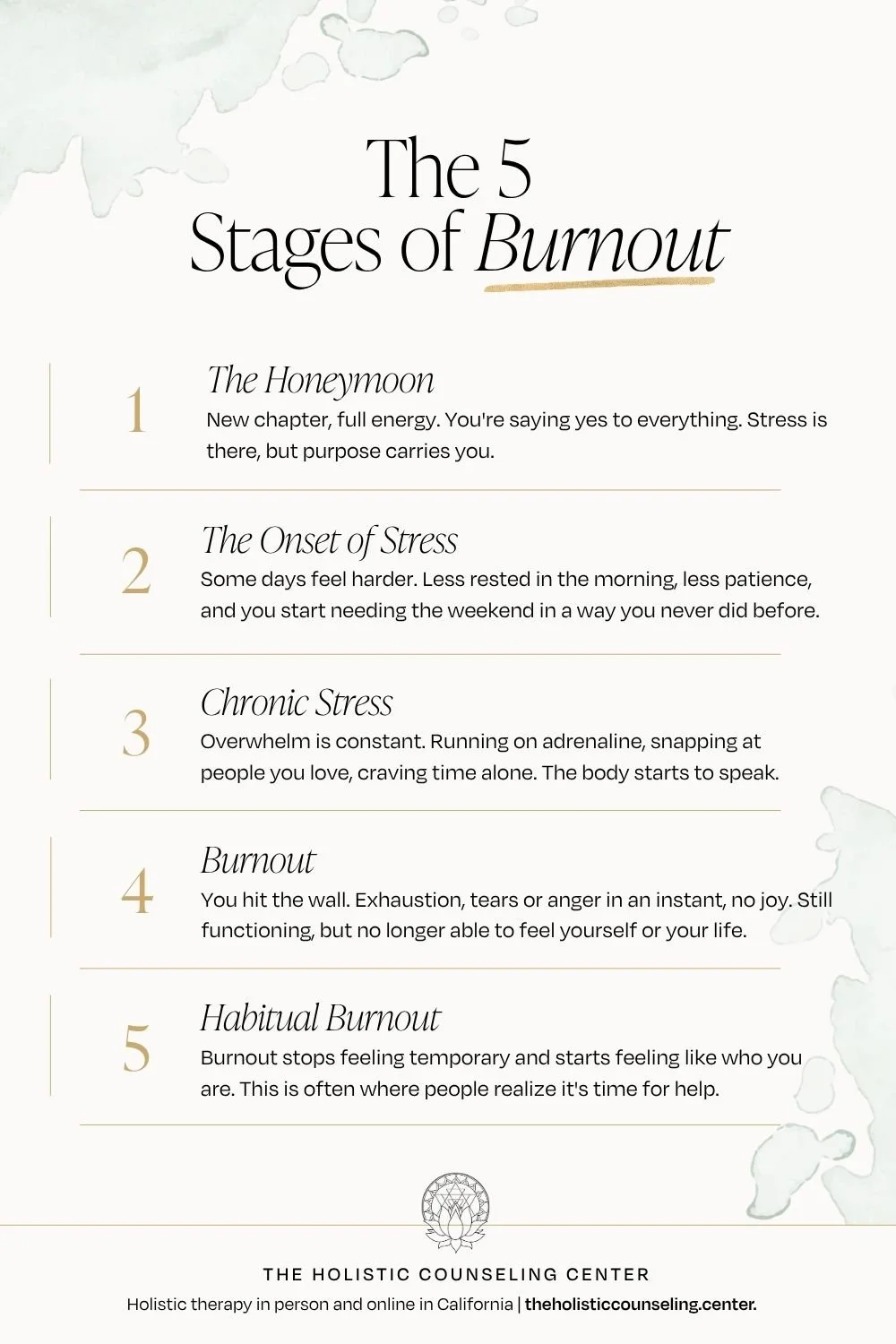
The Honeymoon. Life is exciting and you’re all in. New role, new relationship, new baby, new chapter, and you’re energized, committed, saying yes to all the things that light you up. The stress that comes with change and new beginnings is already there, but purpose and momentum keep you going.
The Onset of Stress. The first storm clouds roll in. Some days start to feel harder than others. Joy and purpose are harder to access. You feel less rested in the morning, you have less patience with yourself and others, and you start needing the weekend in a way you never did before.
Chronic Stress. The overwhelm feels constant. You try to move faster in an attempt to stop drowning in tasks, but you can’t respond to anything fast enough. You’re running on adrenaline most of the day, snapping at people you love, and craving time alone in a cave where no one will talk to you. The body starts to speak, and new aches and pains show up. You keep saying you’ll slow down and take care of yourself ‘soon’.
Burnout. You hit the wall. Exhaustion is constant, tears or anger come in an instant, nothing feels joyful anymore. All the passion and purpose is nowhere to be seen and you are just surviving every day. You may still be functioning, but you are no longer able to feel yourself or your life.
Habitual Burnout. Burnout stops feeling like a bad day that’s going to end soon and starts feeling like who you are. You can’t quite remember another way of being or living your life. This is often the stage where people finally realize that something is amiss and that it’s time for help.
Breathe with me here. Wherever you find yourself here, no matter what stage, know that it’s not permanent. Burnout is not a life sentence. It’s an SOS from your nervous system and the deeper part of you that knows, this is not all there is in life.
You won’t be surprised to hear this, but the earlier you spot this pattern, the easier it is to find your way back to yourself.
How to Recover from Burnout
When clients ask me how to actually heal burnout, my answer is always the same three things: do less, slow down, and connect.
Easier said than done, I know. But the recovery journey begins with small everyday moments. Let’s take the three antidotes to burnout one at a time.
1. Do Less
This one might be the hardest to hear, I know. Because everything in you wants a protocol, a practice, something you can do to make it better. A morning routine, a supplement stack, a mindset hack or guided meditation that will let you keep this pace and feel better while you do it. I get it, because I used to want that too. I couldn’t see a way off the merry-go-round so I kept trying to find a way to enjoy it more. But you cannot add more tools or practices to a system that is already too full.
And I know what you might be thinking…if it’s some version of: “I cannot slow down right now!” or “There is no way anything can come off my plate in this season.” …stick with me.
If you’re a working mom, if you’re running a company, if you’re rebuilding your life after a loss or a diagnosis or a crisis, I get it, there are very real things you have to tend to just to keep your life running.
So let’s define burnout recovery differently than the simple rest more approach. Because we both know a vacation or a spa day isn’t going to completely repattern your childhood wounding and nervous system overwhelm.
Recovering from burnout isn’t about escaping your life either. It’s about learning to tend to yourself inside of it. It’s about the energy you bring to yourself and your day, moving through it with compassion, presence, and finding a way to connect to a loving energy to support and sustain you.
So here’s how to make sense of actually doing less in your life while practicing burnout recovery techniques. Remember the too-full nervous system image from earlier in this article? Burnout is too much coming in, and not enough moving through.
Less coming in starts with an honest life inventory for this particular season. Look at the next few days, next week, next month, and ask: Is there anything I can prune? Cancel? Outsource? Simplify? Anything that comes off your plate, even something small, means less input for an overstimulated nervous system to process. Sometimes the most healing thing on your to-do list is the one you say no to.
2. Slow Down
I find this practice to be the easiest to fold into your healing journey. This medicine is all about doing what you’re already doing, just a little bit slower. Walking from one room to the next just a little bit slower. Drinking your morning coffee just a little bit slower. Breathing in and out, just a little bit slower.
Slowness builds presence, and presence is how we reclaim what burnout takes from us: the ability to connect, to ourselves, to each other, to Source.
Try this. The next time you notice your hand reaching for your phone, pause. Put the phone down. Put your hand on your heart instead. Take one deep breath, and let the exhale be longer than the inhale. That’s it. It costs you nothing, it won’t make you late, and it teaches your nervous system that you are someone who is available for loving care and presence.
I’m here to remind you that you don’t need a different life, job, partner, or a vacation to start feeling better. You don’t even need much to change in the outside world. You need small moments of turning inward instead of outward, and those are available to you right now, for free, in the middle of everything.
Do that enough times and something starts to shift. And it’s not because you added a magical practice, but because you changed the flow of energy and attention. You’re not outwardly scanning for what the world needs from you. You’re listening for what you need. That’s the core of the practice, and it’s the beginning of the way back home to yourself.
3. Reconnect
Doing less creates spaciousness. Slowing down brings you back to yourself. Connection, the heart of the healing journey, is finally available when there’s a gentle, quiet opening.
This is the most important medicine when recovering from burnout because it touches the head, heart, body, and soul. It’s also the hardest to prioritize when you’re running on empty. It can feel easier to cancel your plans to keep working, send a text instead of calling, and quietly stay busy while assuring everyone around you that you’re just fine.
Learning to reconnect, with your own heart, with those you love, and with the wild beautiful around you, is where burnout recovery really starts to take root.
This concept is so important that it gets an entire section all its own, just ahead. Hold onto the word for now: connection. It’s where we’re headed.
7 Ways to Heal Burnout
Before we dive deeper into the gifts of connection, let’s look at what you can actually do to complete the stress cycle and start recovering from burnout. These seven practices are how the stress already living in your system finally gets to move through. Please remember, they are not more things to do. They are completions, and most can be done with just a few minutes a day.
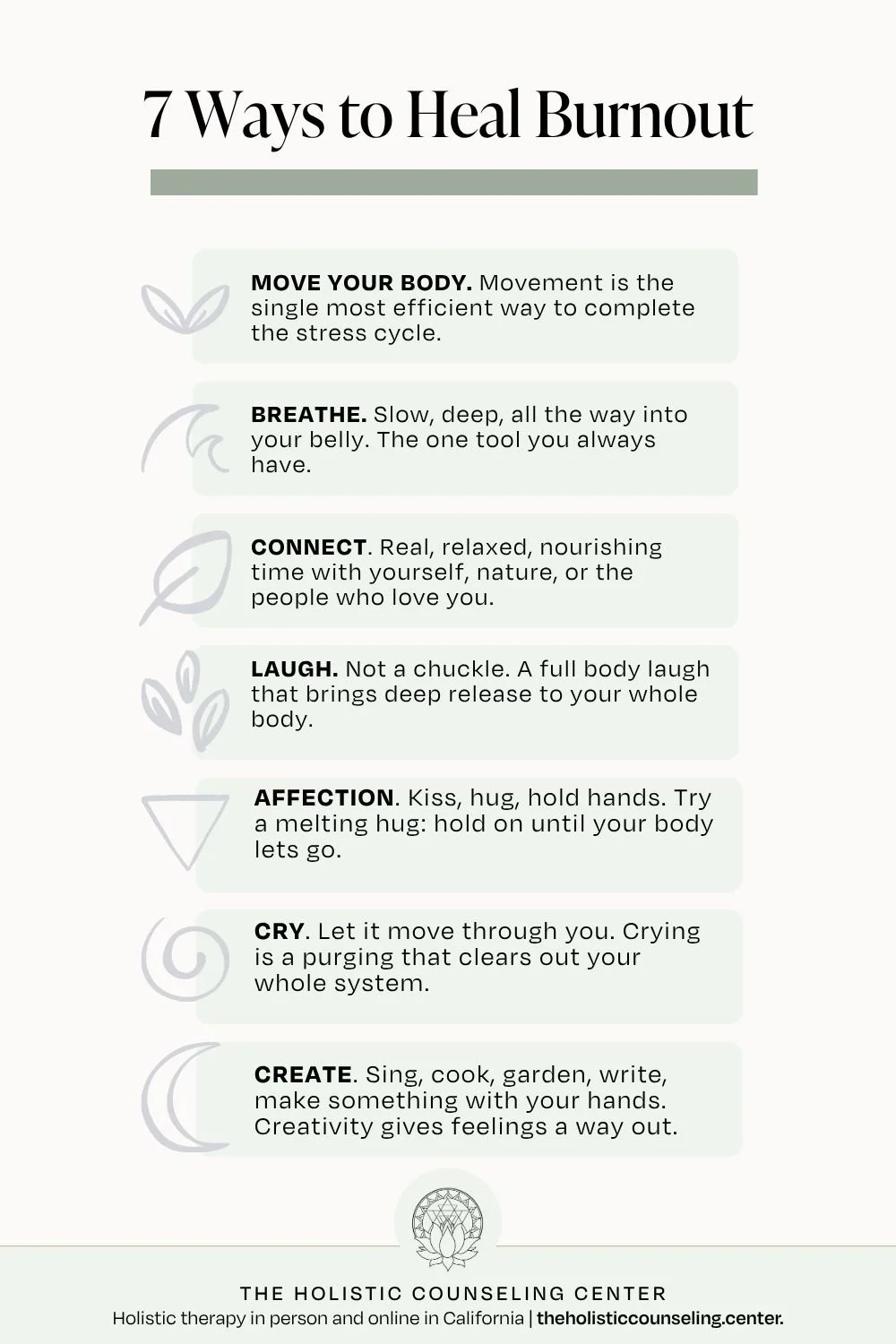
All seven categories come from Emily and Amelia Nagoski’s research in their book Burnout. The way each one is practiced here is mine, informed by years of doing this work with clients and practicing it myself.
Move your body. Movement is the single most efficient way to complete the stress cycle. Running, dancing, swimming, yoga, walking fast enough to get your heart rate up. You’re not exercising to change your body. You’re moving so the stress has somewhere to go.
Breathe. Slow, deep, and all the way into your belly. Maybe add some sound and a little shaking on the exhale. Breath is the medicine, and it’s the one tool you always have with you. (If you want to be walked through it, start with one of our free guided meditations.)
Connect. Real, relaxed, nourishing time with yourself, nature, and/or people who love you.
Laugh. Laugh like you mean it. And not just a chuckle, but a full body laugh that brings a deep release to your whole body.
Affection. Kiss, hug, hold hands, snuggle up. I recommend a melting hug: hold on for a full minute, until you feel your body actually let go. Meaningful contact without a phone in your hand is one of the best things you can do for your nervous system.
Cry. Let it all move through you. Crying releases more than just emotion, it’s a purging that clears out your whole system.
Create. Sing, cook, garden, write, make something with your hands. Creativity gives the feelings a way out.
Now, here’s one place you can trip up: making this list seven more things ‘to-do’ or seven ways you are failing at life every day if you don’t do them.
It’s a subtle self-sabotage, the way self-care turns into a to-do list, and the to-do list turns into more pressure, and the pressure feeds the exact stress cycle you’re trying to navigate. When self-care becomes another task, it doesn’t work anymore.
The key isn’t to do all the practices, the key is to start.
Start with a one-minute practice, folded into the day you already have. You are not adding a new practice, you are letting yourself live, connect, breathe deep, and return to yourself. Yes, even for just one minute a day. Over time you will start to notice, more and more, the ways in which you can slow down your breathing, make the hug last a little bit longer, make space for the tears to come on your evening commute, or call a friend instead of text.
The Best Medicine Is Connection
You can do everything on the burnout recovery list and still not heal.
Why? Because the deepest medicine for burnout isn’t a practice that you do. It’s connection. Deep, authentic connection, with self, others, nature, and Source.
We are psychologically wired to be in connection with other people, and from a spiritual perspective, we are interdependent by design. We actually can't survive all alone. It’s part of why solitary confinement is one of the harshest punishments we have. Cut off from human contact, people slowly lose connection to themselves and their own humanity. Nobody is living alone in an ecosystem here. And still we isolate, we pull away, we protect ourselves. Which makes sense, because relationships are hard, and they can be painful. But the pulling away is exactly what keeps the stress cycle spinning in your system.
Here’s what the science shows us, and it’s beautiful. When two people are together in a room, their bodies begin to synchronize. Researcher Ruth Feldman has documented mothers and infants synchronizing their heart rhythms within a single second of one another during moments of connection. In a landmark study by James Coan and colleagues, women facing the threat of a mild electric shock showed measurably less activation in the brain’s threat centers simply because they were holding their partner’s hand. Not talking. Not solving anything. Just held.
This is the magic of co-regulation, a concept that sits at the heart of polyvagal theory and Stephen Porges’ work on the nervous system. At its core, the idea is simple: Your body reads the presence of another safe body as evidence that the danger has passed. Your heart rates settle. Breath patterns fall into step. The system that has been bracing for months or years, or a lifetime, finally gets the message it’s been waiting for: you can surrender now. You’re safe. I’m here. You’re not alone.
Connection isn’t one more thing to do. It’s how you let biology do the healing. It’s giving your body the conditions to do what it already knows how to do: reset, reconnect, and discharge what it no longer needs to carry.
“Perfectionism, people-pleasing, and old attachment patterns are programs, most of them written in childhood, still running in the background of a very full life.”
Remember earlier, when I said I couldn’t wait to share the missing piece with you? This is it: self-care and being cared for are not the same thing. You can tend to yourself beautifully and still be everyone’s support person who no one is holding. That gap was never going to be closed by another technique. It closes when you let yourself be supported.
A big part of the challenge is that our whole culture is built to keep us separate.
Screens instead of faces. Texts instead of voices. Inside instead of outside. You already know this. But if knowing were enough, we’d all be doing it already. The shift comes when we notice, gently, that the way we’re all living doesn’t serve our nervous systems, and then shift, slowly and surely, in the direction of what does:
Spend one minute outside when you wake up, before you grab your phone
Call a friend instead of texting
Take a walk or sit outside before you start scrolling
Put the coffee date on the calendar and protect it like a meeting with your boss
Hold hands with your partner at the dinner table
Snuggle your fur baby, kiddo, partner, or friend
Take one unhurried minute to check in with yourself: How am I, really? What do I need right now? Connection with yourself counts too.
Let yourself be with something bigger: the sky, the trees, a prayer, a moment of gratitude. Connection with nature and Source is medicine all its own.
Look into the eyes of another person. Touch another person. Be in the presence of another person.
These are the things that heal us.
It’s not another task. It’s learning how to surrender to the natural process of healing.
How Long Does It Take to Recover from Burnout?
Let’s answer the question you’re probably asking: how long does burnout recovery take? The honest answer that no one wants to hear is that it depends. For some people, real relief comes in a few weeks. For most, it’s months. And if you’ve been running hot for years, give the recalibration at least a season or more.
The timeline depends on how deep in it you are, how long you’ve been there, and more than anything, whether real changes can happen in your day-to-day task load, your pace of moving through life, and your capacity for prioritizing connection.
Recovering from burnout is not about finding time to pause, it’s a complete recalibration of your way of moving through life. And at the risk of sounding trite, it’s the opportunity to realign with what matters, your values, your relationships, and your work here on this planet.
When you are honing a new skill, or building new muscles, you take time to learn, to practice, to do the strength training and put in the reps to become masterful at something.
Your nervous system needs time to grow, expand, and build new capacity, and that is not a one weekend project. You deserve the time, the care, the growing pains that come with learning to deeply love and care for yourself.
So I’m here, inviting you to set reasonable expectations, and let them be this: burnout recovery is hard. It takes time. Most of us want it to be easier than it is, and then come down on ourselves when it isn’t.
You are literally being asked to rebuild your nervous system, one circuit at a time. Stating the obvious here but it’s a big deal. And you deserve a mountain of patience.
If percentages give your brain something to orient to, I got you. In their book, Burnout, the Nagoskis give us the 42% rule. They looked at what the science of rest actually asks of the human body, and it turns out that 42% of your time should be spend ‘resting’. That’s roughly ten hours a day. Before you laugh out loud and close your browser, let’s break it down: it counts a full night of sleep, unhurried meals, movement, and legit downtime.
We’re not talking about 42% of your day lounging around eating bonbons. It’s about prioritizing life outside of work and the to-do list, reorienting so that rest becomes part of your day, not just a reward you earn after your work is done. And the Nagoskis offer a warning worth passing along: “if you don’t take the 42 percent, the 42 percent will take you.” Burnout is often exactly that: the rest you kept postponing, coming to collect what’s due.
To put it simply: rest is a biological requirement.
However long it takes you to recalibrate, it’s worth it. Because what’s waiting on the other side isn’t just feeling less tired.
The Deeper Healing: From Burnout Back to Joy
Most burnout advice offers functional, task-oriented practices like restoring your relationship to sleep, managing your inbox, working out again, and not working 12 hours a day. And if all you want is to stop drowning in the feeling that life is too much, those practices will get you there.
But if you stay with the deeper practices, let yourself tend to the roots of your burnout, and truly learn to care for yourself, there is so much more that opens up.
I hope you can sense by now that regulation isn’t the destination when healing from burnout. It’s the doorway. And one of the big things I’ve learned from this work is that we can only go as deep as our nervous system feels safe to go. When you finally learn to feel safe in the world, when you’re no longer spinning on an out-of-control merry-go-round, you can learn to connect deeply, to self, to Source, to others. And the gifts waiting there are joy, bliss, ecstasy, and love. Not in a cliché way, but in the embodied, somatic way that changes who you are at your core.
This is the full arc of the healing journey: find safety in your nervous system, reconnect with your heart, remember who you are.
When you stay on the path of burnout recovery, the joy comes back. Slowly, and usually in small, everyday moments: you catch yourself actually tasting your food, hearing the birds, dropping into the hug you’re being offered.
You learn that your capacity for joy and ease that burnout drained is not actually gone. It’s been waiting underneath the to-do list the whole time. (Want to learn more about this topic? I wrote a whole piece on how to increase your capacity for joy.)
And somewhere along the way, gratitude comes online again. You learn you can hold both, the hard stuff, and the celebrations. You learn that life is hard, and it’s also beautiful.
This is what healing and wellness actually are. It’s your capacity to move through the stress and come out the other side still being able to smile, connect, love, and be loved. It’s not that you’ll never feel stress again, or never brush up against burnout again. It’s that you’ll have the tools to recognize it, move through what’s hard, and move through it faster, so you suffer less. You metabolize as you go, so it never has to pile up like this again.
This is the deeper healing through burnout. It’s not about returning to who you were before you burned out, but becoming the next evolution of yourself, lessons learned, heart strengthened, and a renewed connection to your own tenderness, capacity for growth, and the magical gift that is you.
Therapy for Burnout: How We Can Help

If this article has been one long moment of recognition, I’m glad you’ve made it this far. This is your invitation to slow down and reach out for support.
You are allowed to reach out before you are in full-blown burnout, before you’re in a crisis, or at any stage of the journey. Therapy offers a safe space to slow down and learn to care for yourself, learn practices for regulating your nervous system, and process the patterns and pain that led you here.
At The Holistic Counseling Center, we treat burnout holistically, helping you heal at the root, not just manage your symptoms. Our therapists weave together somatic therapy and polyvagal-informed work to help you learn to regulate your nervous system and reconnect you with your body, IFS therapy to befriend the over-functioning parts of you and the inner voice that says you’re never doing enough, psychodynamic and depth work to unearth and rewire the old patterns and programs from childhood, EMDR and Brainspotting to process unhealing trauma, spiritual therapy to help you reconnect to your Highest Self and align with your values, and mindfulness to help you rebuild your capacity for presence and deep rest.
You can learn more about our approach to therapy on our burnout therapy page. We’re currently accepting new clients for online therapy throughout California and in-person sessions in San Francisco, San Anselmo, and El Dorado Hills, with evening and weekend appointments available.
Taking the first step is simple:
Schedule a Free Consultation Call: we’ll explore what’s bringing you to therapy and answer your questions.
Get matched with a therapist who feels like the right fit. You can also speak with your recommended therapist before your first session.
Begin your healing journey. One session, one exhale at a time.
Takeaway
Burnout is chronic stress your body can no longer metabolize. It means your nervous system has been carrying more than it could process, for longer than it should have had to. The medicine is not another protocol. It’s doing less, slowing down, and reconnecting. Healing happens breath by breath, moment by moment, and it can start right now: one longer exhale, one thing off the list, one hand on your heart. You are not alone in this. And when you’re ready for support, we’re here.
Book a free consultation call to get matched with a burnout therapist.
Additional Resources for Your Burnout Healing Journey

References
Coan, J. A., Schaefer, H. S., & Davidson, R. J. (2006). Lending a hand: Social regulation of the neural response to threat. Psychological Science, 17(12), 1032–1039.
Feldman, R., Magori-Cohen, R., Galili, G., Singer, M., & Louzoun, Y. (2011). Mother and infant coordinate heart rhythms through episodes of interaction synchrony. Infant Behavior and Development, 34(4), 569–577.
Freudenberger, H. J., & North, G. (1985). Women’s burnout: How to spot it, how to reverse it, and how to prevent it. Doubleday.
Nagoski, E., & Nagoski, A. (2019). Burnout: The secret to unlocking the stress cycle. Ballantine Books.
Porges, S. W. (2011). The polyvagal theory: Neurophysiological foundations of emotions, attachment, communication, and self-regulation. W. W. Norton & Company.
World Health Organization. (2019). Burn-out an “occupational phenomenon”: International Classification of Diseases.
Mental Health America. (n.d.). Burnout: Signs, causes, and how to recover.

About the Author
Kim Burris, LMFT is a licensed holistic psychotherapist, founder of The Holistic Counseling Center, and author of The First 90 Days After Birth. Her work has been featured in Vogue, Bustle, and the Daily OM.
She honors the mind-body-spirit connection and offers evidence-based psychotherapy with a heart-centered approach that helps people find relief from anxiety and self-sabotage so they can live life with more joy, freedom, and ease.
Kim and her team currently offer holistic counseling in El Dorado Hills, San Francisco, San Anselmo, and online throughout California. Click here to book a no-cost consultation call and get matched with one of our holistic therapists.
Disclaimer: This content is for informational purposes only and is not intended to be a substitute for professional medical advice, diagnosis, or treatment. Always seek the advice of your physician or qualified mental health professional.