What Is a Dark Night of the Soul?
“In darkness, we become devoted to clarity, courage, peace, and harmony. We discover the basic goodness of all humanity when we experience darkness together.” - Zenju Earthlyn Manuel
A dark night of the soul arrives when the ground beneath you gives out. When what you've been anchored to, connected with, and deeply trusted detonates, dissolves, or simply disappears. You might call it a loss of faith, an existential crisis, a spiritual betrayal or a deep loss of what used to bring you meaning, purpose, and direction. Whatever the name, the experience is similar: despair, rumination, fear (or even terror), and grief. So much grief.
And then the big questions arrive: What do I believe in now? Will I ever feel joy again? Will I ever trust in anything again?
It feels heavy. Like you’re a thousand pound weight sinking in the ocean.
If you found your way here, you’re probably trying to figure out whether what’s happening to you has a name. Whether it’s depression. Whether it’s a spiritual emergency. Wondering if it ever ends. I’m glad you’re here.
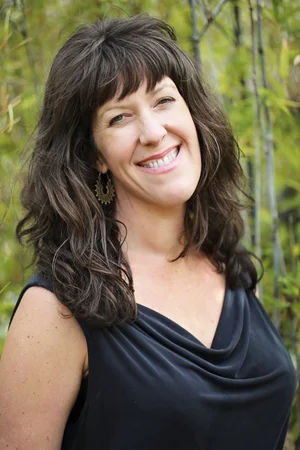
I’m Kim Burris, a licensed marriage and family therapist, founder of The Holistic Counseling Center, and a therapist trained in transpersonal psychotherapy, which I’ve also taught to graduate students at the California Institute of Integral Studies (CIIS). I’ve been through my own dark night of the soul (to be honest, a handful), and managed to not only survive, but grow through it all. I’m writing this as both a clinician with the knowledge and skills to offer support, and the person who has also been where you are and come through to the other side.
In this article we’ll look at what a dark night of the soul actually is, the symptoms you might notice, how it relates to depression, what helps with healing, and when it’s time to reach out for support.
What Is a Dark Night of the Soul?
A dark night of the soul is a spiritually and psychologically destabilizing period that can look and feel like depression or trauma. The meaning of life disappears, faith and spiritual beliefs go silent or fall away, and you may not recognize the tired, hopeless, disoriented version of yourself that you see in the mirror. It’s painful, and it’s also a portal to transformation: a passage that asks you to surrender to not-knowing and trust a deeper unfolding.
The phrase itself is old. It comes from St. John of the Cross, a sixteenth-century Spanish mystic who wrote about a long season of spiritual desolation, when everything that had once connected him to the sacred went dark.
Centuries later, Carl Jung read that same descent through a psychological lens, as a necessary period of crisis and disorientation that comes before real growth. “One does not become enlightened by imagining figures of light,” he wrote, “but by making the darkness conscious.”
What I love is that the mystics didn't see the dark night as a mental illness. They saw it as an initiation, the stretch of the spiritual path where the lights go out, and you have to find your way through the darkness, and be utterly transformed in the process.
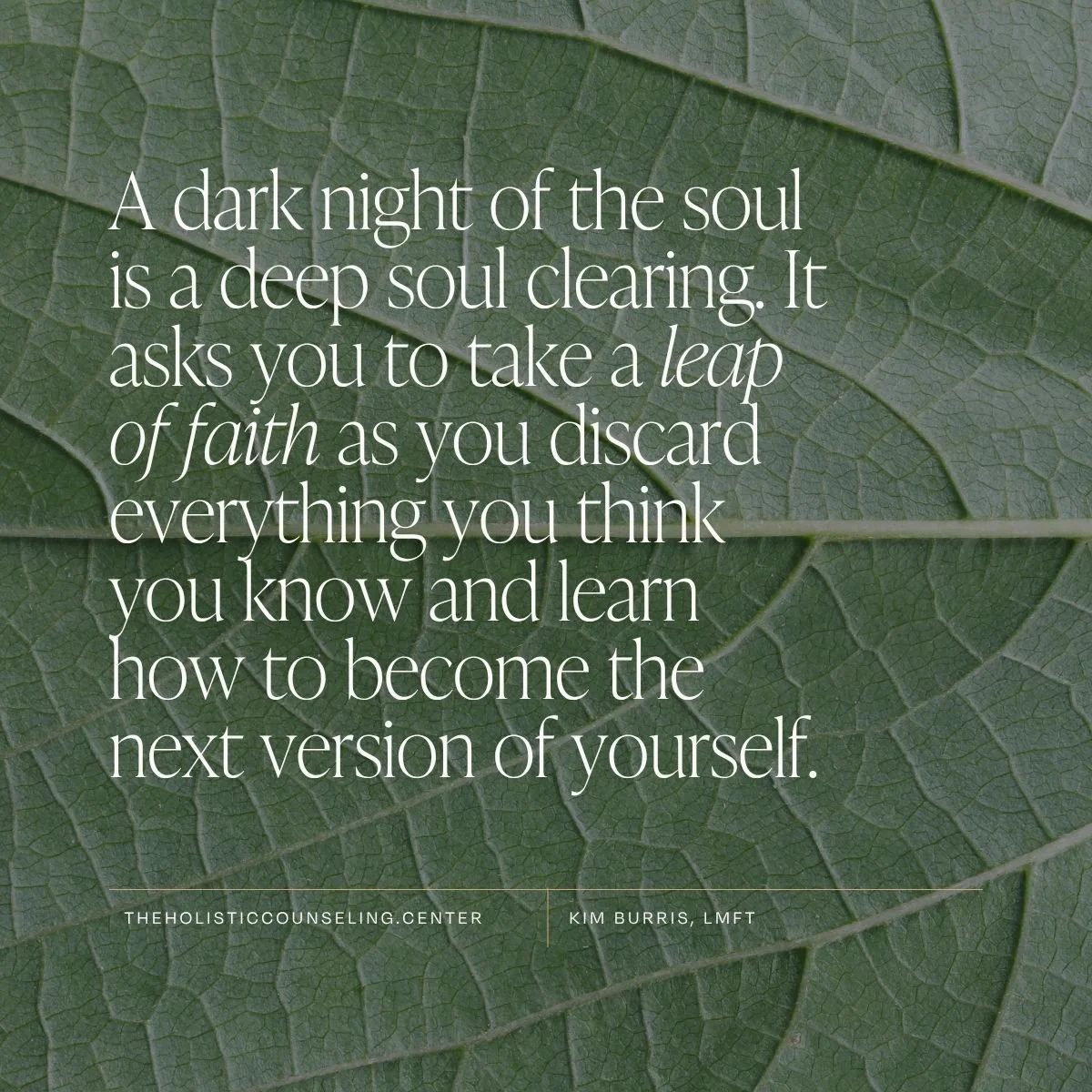
Here’s how I see it. A dark night of the soul is a deep soul clearing. It asks you to take a leap of faith as you discard everything you think you know and learn how to become the next version of yourself.
A dark night of the soul is one face of a spiritual awakening: a crisis that is also an opening. It’s the quiet face, the emptying, when it all goes dark and you have to keep walking through the storm.
A spiritual awakening can also arrive like a flood, with too much coming in. Too much energy, info, insight, sensation, and your nervous system short circuits. Transpersonal psychology calls the waking up itself a spiritual emergence, your consciousness emerging and waking up. When it becomes completely destabilizing, when you can’t function in your daily life, it’s called a spiritual emergency.
If you read one thing here, let it be this: A dark night of the soul is not a punishment. It’s a sign that something sacred in you is emerging. That doesn't mean we call it a gift and try to find gratitude for the experience, because that would be spiritual bypassing and we don’t do that around here. It's not about finding what's good about it. It's about honoring the way through it.
For now, I want you to know that it has a name, and that you’re not the only one facing a total recalibration of who you are.
Here’s what a dark night of the soul actually looks like.
Dark Night of the Soul Symptoms
The symptoms of a dark night of the soul overlap with depression and can feel like ‘life is just hard,’ which is why so many people go years without a name for the experience. When we look deeply, there are some recognizable symptoms on the journey:
Loss of meaning and purpose. You are unmoored and disconnected from work, relationships, and all the practices that once nourished you. Nothing feels alive anymore.
Your spiritual life goes offline. Prayer feels uninspired. Meditation feels like sitting in a room with your mind and nothing else. Your connection to Source has gone silent and it feels like you’ve been abandoned.
Your body feels a deep, soul-wrenching ache. You’re tired, heavy, numb. Nothing motivates you and the ache feels like it’s drowning you.
You don't recognize any part of yourself. I don't know who I am anymore. The roles that used to define you fit like a coat that belongs to someone else, and the things you used to call sacred don’t align anymore.
The big existential questions won't quiet down. Why am I here? Why is there so much suffering? What's the point of it all? These aren't intrusive thoughts. They're the big questions, arriving at full volume.
Grief. Grief. Grief. You may be grieving a belief, a person, a past version of yourself, or future dreams you’re no longer sure of.
You quietly withdraw from life. You stop reaching out and retreat because explaining any of this feels impossible, and being seen feels like way too much.
If you're nodding along and see yourself on this list, you're in the right place. You might also be reading it and thinking: wait, isn't this depression? Let's get into it.
Looking for a therapist to help you navigate a dark night of the soul?
Our therapists can help. Book a no-cost consultation call to get started.
Book a Free Consultation Call
Is This Depression or a Dark Night of the Soul?
Ask a psychiatrist about your symptoms and you'll hear depression. Ask a mystic and you'll hear a dark night of the soul. Ask me, and I'll tell you they're often two sides of the same coin, and which side you see depends on the lens through which you look at life.
The traditional medical model, or clinical lens sees depression as a disorder: a diagnosis, a problem to be fixed. The mystical lens, which is also the lens of spiritual, or transpersonal therapy, sees a dark night of the soul as something that has come to teach you.
Here at The Holistic Counseling Center, we are licensed clinical and spiritual therapists. We don’t see your symptoms as just depression, or something to be gotten rid of. We honor your symptoms as a type of spiritual depression, and honor them as a deep longing to explore the places that open up when things fall apart.
When you feel into it, depression and a dark night of the soul carry different energies. Depression is more of a suppression, a pause or stuckness in the flow of life force energy. A dark night of the soul has a pulsing, almost frantic energy that's seeking something. It's a rebirth that can be tough to navigate when you're deep in the process.
Eduardo Duran, a psychologist who has spent his career working in Native communities and draws on the healing traditions of his own ancestors, writes about depression as soul sadness: unresolved grief, sometimes carried across generations, that our profession learned to call by the diagnostic name depression. He so beautifully teaches that instead of viewing the depression as a disorder to be eliminated, the symptoms can be something we can be in relationship with. In the traditions he draws from, an illness arrives, and we can ask it what it came here to teach us.
So, is what you’re experiencing depression or a dark night of the soul?
At the end of the day, I'm not sure it matters what we call it. Here at The Holistic Counseling Center we treat it all: Depression. A dark night of the soul. Soul sadness. A spiritual awakening. Spiritual depression.
What matters is that you recognize when you’re in it, so you can find the practices and the support you need to move through it.
Before we talk about healing, one more question worth sitting with: how did you end up here?
What Triggers a Dark Night of the Soul?
Sometimes there's a doorway. The death of someone you love. A loss of faith or leaving your spiritual tradition. A divorce or a separation. A diagnosis that rearranges your future. Leaving a homeland, a family, a lineage. These are the big events that drop us down into the densest parts of being human, and a dark night often begins in the weeks or months after one of them.
And sometimes there's no noticeable doorway at all. Nothing big or traumatic happened. Life just kept happening and the fertile soil slowly eroded, leaving you with a lackluster, quiet, but deeply painful ache. You don’t need an event or a good enough reason to be moving through a dark night of the soul. If you’re suffering, that’s enough.
There's a thread in the psychology literature I keep coming back to. The researcher Yochai Ataria interviewed people who had lived through severe trauma, including former prisoners of war, and separately interviewed long-time meditators about their deepest experiences in practice. Both groups reached for the same words: nothingness and emptiness.
Ataria suggests that mystical experience and traumatic experience may be two encounters with the same nothingness, approached from opposite directions, and that the dark night of the soul may be what a mystical experience looks like turned upside down, what one researcher called a "painful sense of nothingness."
He is careful to call this a theory rather than a proven fact, and so am I. And it leaves me with this question: what if a dark night of the soul is the traumatic face of a mystical process? Or the mystical face of a traumatic one?
Meaning... The bottom of the ocean you've sunk to may be the same harrowing place the mystics wrote about. That doesn’t make it hurt any less. But it does mean there are people who have moved through this, and they can illuminate the path. So let's talk about healing a dark night of the soul.
How to Move Through a Dark Night of the Soul
There is a way through a dark night of the soul. Over years of sitting with people navigating this terrain, and moving through it myself, I've come to see that a dark night of the soul has a typical unfolding, and it moves through three phases:
The Way Through a Dark Night of the Soul
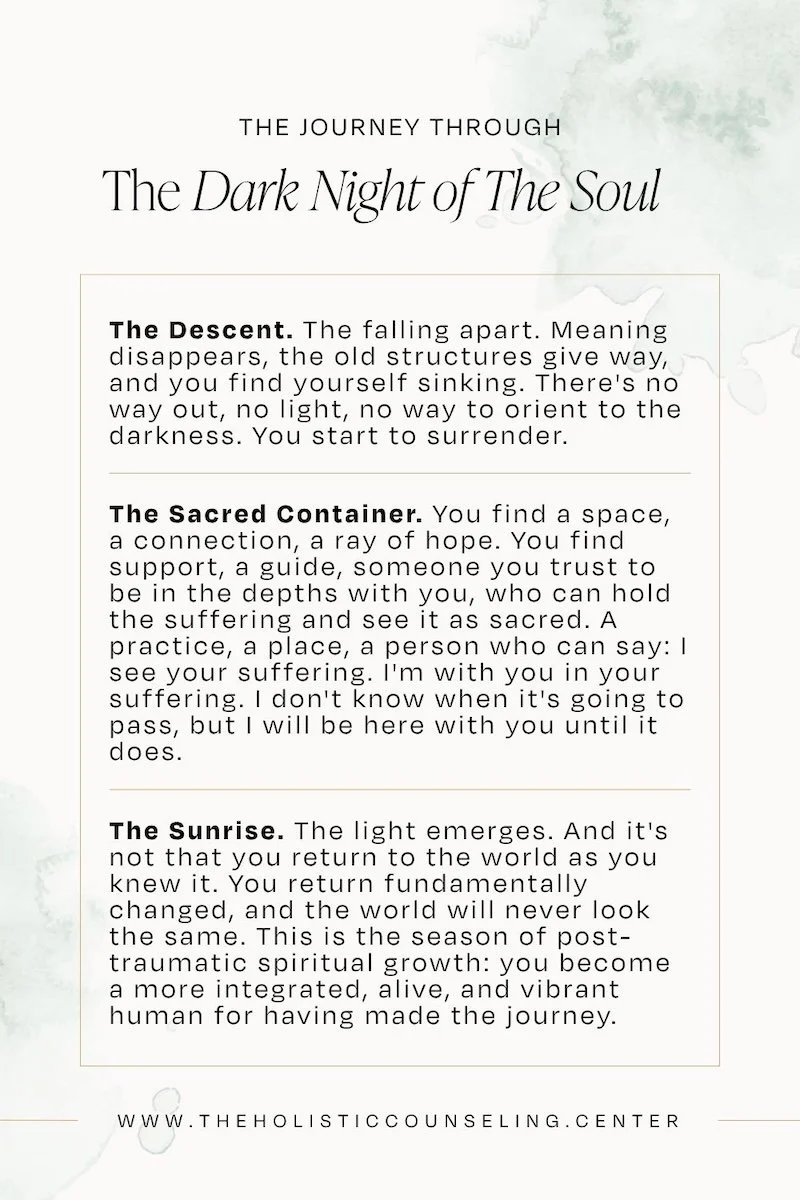
The Descent. The falling apart. Meaning disappears, the old structures give way, and you find yourself sinking. There's no way out, no light, no way to orient to the darkness. You start to surrender.
The Sacred Container. You find a space, a connection, a ray of hope. You find support, a guide, someone you trust to be in the depths with you, who can hold the suffering and see it as sacred. A practice, a place, a person who can say: I see your suffering. I'm with you in your suffering. I don't know when it's going to pass, but I will be here with you until it does.
The Sunrise. The light emerges. And it's not that you return to the world as you knew it. You return fundamentally changed, and the world will never look the same. This is the season of post-traumatic spiritual growth: you become a more integrated, alive, and vibrant human for having made the journey.
Healing Practices for a Dark Night of the Soul
At the heart of healing a dark night of the soul is inquiry: learning to tune in and deeply listen to yourself, and then nourishing the body while the soul does its work. Notice which of these practices speaks to you, and give it a try.
Journal, stream of consciousness. Julia Cameron's The Artist's Way is one of my favorite ways to do deep inquiry work.
Pray, chant a mantra, or sing. Out loud. Frequency reaches places the mind can't.
Read the mystics and the sacred texts. People have walked this road before you and left maps. I've gathered a list of my favorite books, you can download below.
Work with a therapist or spiritual teacher. None of us are meant to heal alone, and the suffering of a dark night gets worse in isolation. Find a therapist or spiritual teacher trained to sit in the dark with you and ask the questions you can't yet ask yourself. A friend who has walked this road. Or a community that can hold you.
Name it, then nourish it. Place a hand on your heart. Say out loud what you're feeling today. Grief is welcome. Numbness is welcome. The hard part is staying with your experience long enough to really be with it. Then nourish it.
Make something. Paint, write, move, garden. Creative expression is inquiry with your body.
Choose solitude, not isolation. Solitude is a retreat toward yourself and toward God, the universe, Source, whatever you call the sacred. Isolation hides from the world because you feel unlovable or not enough. If you're not sure which you're in, ask whether you're turning toward something or away from everything.
Reach for a spiritual tradition that resonates now. If your old tradition no longer holds you, you're allowed to look for a different one, or for the simplest forms of all: a prayer, a mantra, a song, a service you attend for no reason other than that it reawakens the part of your heart that is still holding hope.
Get outside. More than feels reasonable. Bare feet on the ground if you can.
Eat warm, real food, and sleep. The basics are the foundation for the new way of life you are building.
The healing of a dark night of the soul can feel like being wrapped in a cocoon. It feels good and it feels terrifying, both at once. Things get darker before the light comes again, and at some point you have to go all the way in and surrender to it in order to emerge. Duran writes that the pain we carry already contains the spirit of healing within it. I believe that.
One of my favorite songs for this season is Great Storm Clouds by Trevor Hall.
The lyrics go like this:
‘Great storm clouds...
Holding rain…
It's part of nature to hold a bit of pain.
All in all, that rain falls
And then we watch a new thing grow.’
When to Seek Professional Support
You don't have to be in a crisis to reach out for support, and you don't have to know whether this is depression or a dark night of the soul before you do. If any part of this article feels like it was written just for you, that’s more than enough of a reason to reach out for support.
One important note. If you're currently having thoughts of suicide, if you're not sleeping or eating, or if you feel like you're actively in crisis, you can call or text 988, the Suicide and Crisis Lifeline, anytime, day or night. Our crisis resources page has more ways to get help right now if you’re struggling.
And if you're reading this and wondering what to do next, consider this your invitation to the deeper work. You don’t have to know what the path forward is, you only have to be willing to take the next step. That's where we come in.
Therapy for a Dark Night of the Soul: How We Can Help
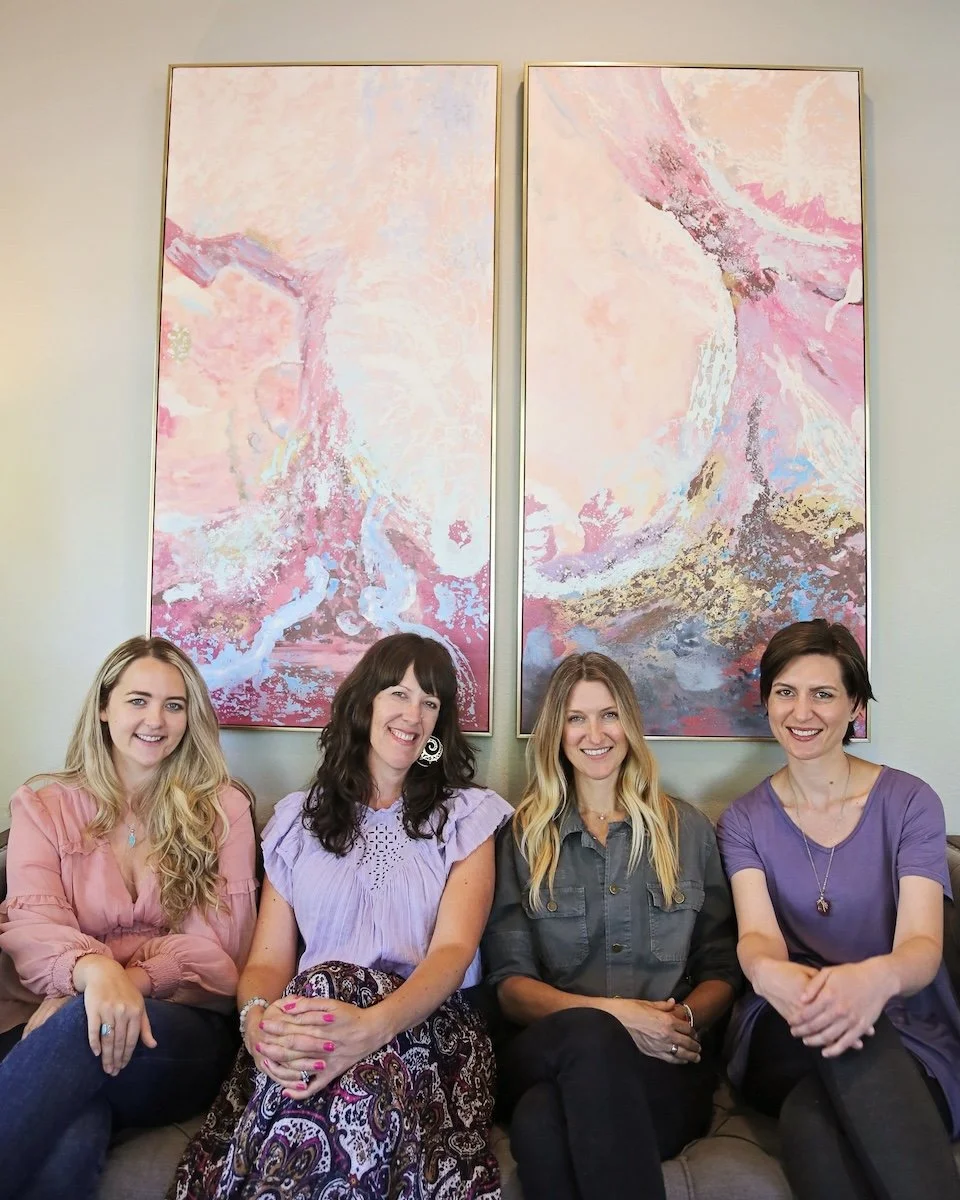
Here at The Holistic Counseling Center, we offer holistic therapy to support you in navigating a dark night of the soul.
Our licensed and associate therapists are clinically trained to treat depression and existential crisis, and to support you through a dark night of the soul or a spiritual awakening.
We integrate traditional psychotherapy modalities like CBT and EMDR with depth therapy, IFS therapy, nervous system regulation tools, somatic therapy and transpersonal/spiritual therapy to support your healing journey.
No matter what you’re navigating right now, we’re here. There's nothing about you or your experience that is too much, too messy, or too hard. We see you, we honor you, and we'll walk through it with you.
We're accepting new clients and would love to support you. We offer in-person therapy in El Dorado Hills, San Anselmo, and San Francisco, and online throughout California.
Taking the first step is simple:
Schedule a Free Consultation Call: We'll learn more about what's happening in your life and answer your questions.
Get Matched With a Therapist: We'll match you with a therapist who feels like a fit, and you can speak with them before your first session if you like.
Begin Your Journey: Have your first session and start finding your way through.
Wishing you well on your healing journey.
— Kim Burris, LMFT
Takeaway
A dark night of the soul is not a punishment, and it's not proof that something is broken in you. It's a soul clearing: painful, disorienting, and often indistinguishable from depression from the inside. You don't have to know which one it is, and you don't have to choose between clinical support and spiritual depth. What matters is recognizing where you are and letting someone walk through it with you. Reach out to get matched with one of our holistic therapists today.
Additional Resources
For those interested in exploring the spiritual side of mental health, here are some additional resources:
Spiritual Therapy and the Benefits of Working with a Spiritual Therapist
Book Recommendations from a Holistic Psychotherapist (Free Guide)
References
Ataria, Y. (2014). Traumatic and mystical experiences: The dark nights of the soul. Journal of Humanistic Psychology. Advance online publication. https://doi.org/10.1177/0022167814563143
Duran, E. (2006). Healing the soul wound: Counseling with American Indians and other Native peoples. Teachers College Press.
Hunt, H. T. (2007). “Dark nights of the soul”: Phenomenology and neurocognition of spiritual suffering in mysticism and psychosis. Review of General Psychology, 11(3), 209–234.
Jung, C. G. (1967). Alchemical studies (R. F. C. Hull, Trans.). In The collected works of C. G. Jung (Vol. 13). Princeton University Press.
About the author
Kim Burris, LMFT, is a licensed marriage and family therapist and founder of The Holistic Counseling Center and the author of The First 90 Days After Birth: A Self-Care Journal for First-Time Moms and her work has been featured in Vogue, Bustle, and the Daily Om.
She honors the mind-body-spirit connection and offers evidence-based psychotherapy with a heart-centered approach that helps people find relief from anxiety and self-sabotage so they can live life with more joy, freedom, and ease.
Kim and her team currently offer holistic counseling in El Dorado Hills, San Francisco, San Anselmo and online throughout California.
Click here to book a no-cost consultation call and get matched with one of our holistic therapists.
Looking for your next favorite book?

Disclaimer: This content is for informational purposes only and is not intended to be a substitute for professional medical advice, diagnosis, or treatment. Always seek the advice of your physician or qualified mental health professional.