
Last Updated: March 1, 2026
Originally Published: September 1, 2024
Are you struggling with anxiety and wondering if there's a deeper, spiritual meaning behind your symptoms? You're in the right place.
As a licensed psychotherapist with over 10 years of experience and a deep foundation in transpersonal (spiritual) psychology, meditation, yoga, and mindfulness, I understand the intense challenges anxiety presents, and I've seen how healing deepens when we're willing to look beyond just managing symptoms.
Most people understand anxiety through a clinical lens: racing heart, intrusive thoughts, shortness of breath, panic attacks. And those are real. But they're only part of the story.
What often goes unrecognized, and unnamed, is how anxiety shows up in your spiritual life.
The disconnection from your intuition. The sense of being unmoored from your purpose. The inner critic that drowns out your quiet but fierce inner wisdom. These are the spiritual symptoms of anxiety, and if you've been experiencing them, you're not alone.
This article will help you recognize six spiritual symptoms of anxiety, understand the deeper meaning behind each one, and explore holistic tools to support your healing.
Ready to dive in? Let's go.
What is the Spiritual Meaning of Anxiety?
Anxiety is a real and valid experience, and for many people it's a diagnosable condition that deserves proper support.
And it can also be something more. An SOS from someplace deeper in you. A signal asking you to listen, slow down, tune in. It's often pointing to where you've become disconnected, where something in your inner world is asking for your attention.
From a spiritual perspective, anxiety is an "up and out" energy, a separation of your spirit from your body. You might sense it as a rising in your chest, a feeling of being untethered, or even like you're leaving yourself. That upward, outward pull is your spirit and body moving out of alignment with one another.
And what connects them? The heart. The heart is the bridge between the soul and the body. When the soul is not in alignment with the mind, the heart, and the body, we experience that separation as anxiety.
So when anxiety shows up, think of it as an invitation to pause and turn towards yourself.
When you get curious about the spiritual meaning of anxiety, you can identify and explore the deeper parts of yourself that are out of alignment, have been long ago abandoned, or are simply not integrated yet.
These spiritual symptoms of anxiety are not signs of weakness or a lack of spiritual depth. They are golden threads, highlighting where healing is waiting, where you may be avoiding your truth, or where you may even be spiritually bypassing.
When you can recognize anxiety as a beacon guiding you back home to yourself, instead of an indication that there is something wrong with you, deep healing and integration can happen.
For a deeper read on the head, heart, and body framework that holds this work together, see the spiritual nature of anxiety.
6 Spiritual Symptoms of Anxiety
When we expand our view of anxiety beyond the clinical and medical model, we start to see how it impacts not just the mind and body, but the spirit. From a holistic perspective, anxiety has spiritual symptoms too, and they deserve just as much attention.
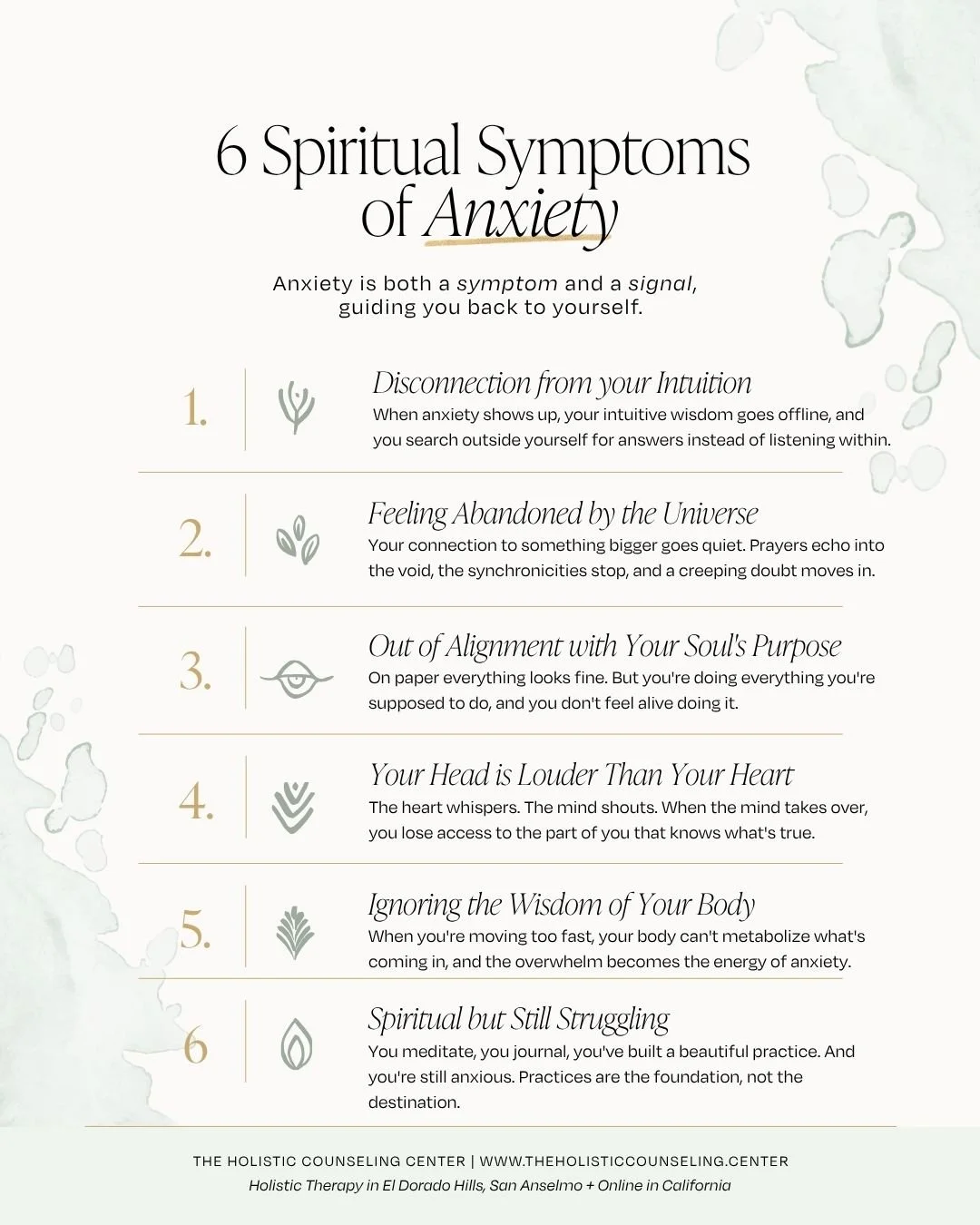
Let's start with an overview of the six spiritual symptoms of anxiety, and then we'll explore each one in depth:
Disconnected from Your Intuition
Feeling Abandoned by the Universe
Out of Alignment with Your Soul's Purpose
Your Head is Louder Than Your Heart
Ignoring the Wisdom of Your Body
Spiritual but Still Struggling
1. Disconnected from Your Intuition
You know that quiet nudge in your gut, the one that says "yes, this!"? Maybe you used to feel it clearly. Or maybe you've always longed for this connection, but haven’t been able to access it yet? Either way, when anxiety shows up, that connection to your intuitive wisdom often goes offline.
The wild paradox is this: when a negative thought shows up, or the inner critic rears its head, you often agree with it immediately. You take it as truth without question. But an intuitive hit? You dismiss it. Doubt it. Talk yourself out of it.
The reason is more simple than you might think: you trust the louder voice because you've heard it more. Your pattern is to trust the voice of an internalized parent, the programming you've inherited from the world, your culture, your upbringing. Your intuitive wisdom, by comparison, can feel unfamiliar, almost too good to be true.
And this disconnection fuels anxiety.
When you don't have a strong connection to your intuition, your body and brain have to work overtime trying to figure out what to do next. You're constantly searching for answers outside of yourself rather than listening within, and the result is overwhelm, decision fatigue, and a nervous system that never gets to rest.
The good news? The connection is never gone. It just gets drowned out sometimes. When something arises that you doubt, if you look a little deeper, and feel a little deeper, you can hear that deeper wisdom and recognize it as your truth. You learn to trust it by listening, and then by acting on it. Over time, as you learn to identify and honor your intuition, some of those heightened anxiety symptoms begin to lessen.
2. Feeling Abandoned by the Universe
This can feel like static on the line. That connection to something bigger: to the divine, the universe, that sense that your life is unfolding with some kind of loving intelligence behind it has gone quiet. The prayers seem to echo out into the void. The synchronicities seemingly stop. And in their place, a gnawing, creeping doubt moves in.
This often shows up when life pushes you beyond your limits, when things get so hard, so disorienting, that you can't make sense of why this is happening to you. You begin to doubt your inner guidance. You doubt that there's any plan or purpose at all. It can feel like a dark night of the soul, and it's one of the most isolating experiences a person can have.
And of course this fuels anxiety. When you don't have that spiritual anchor to hold onto, when the ground beneath your deepest trust gives way, it feels like a freefall. There's nowhere to land. What rushes in is fear, existential angst, a constant wondering about what's next, why now, why me. This fear is at the very heart of anxiety. It settles into your nervous system and takes root, keeping you on edge, unmoored, and in a constant state of mild or full-blown panic.
Here's what I want you to know: at the heart of it all, you can't lose the connection. The energy is always there. The universe is always there. The divine heartbeat of the cosmos still beats.
If your connection to your faith and the greater unfolding is wavering, a gentle reminder: Sometimes things need to fall apart before they get reconfigured in a way that truly serves us.
This isn’t spiritual bypassing, which says everything is love and light and we should be grateful for everything we experience. You can rage. You can grieve. You can question everything.
Sometimes the golden thread, the one thing holding it all together, is just hope.
If even 1% of you is willing to consider that there might be a greater path or purpose unfolding, that can be enough.
This is where spiritual therapy for anxiety can offer support: a place to explore all of this, gain clarity, and reconnect to your spiritual anchor. It often starts as a gentle inquiry: If your life was divinely designed for you, what might be happening here?It's not about finding a silver lining. It's an invitation to soften around the pain, turn toward it, and learn to care for it in a different way.
3. Out of Alignment with Your Soul's Purpose
On paper, everything looks fine. Maybe even good. But underneath it all there's a deep, quiet sense that something is just missing. You're doing everything you're supposed to do, but you don't feel alive doing it. Joy feels distant, or fleeting, or like something other people have access to but you don't.
This is what it feels like to be out of alignment with your soul's purpose, what some traditions call your dharma, your soul contract, the thing you came here to do and learn in this lifetime.
And here's where so many of us get stuck: we tend to think purpose has to look a certain way. That it has to be a specific career, a calling with a capital C, a grand mission. But purpose is less about what you do and more about how you feel on your human journey.
When you can unearth and align with that feeling, rather than chasing a title or a role, something shifts, like a big exhale in your whole system, and you begin to realign with your unique and personal purpose.
The tension underneath it all is often a fight between the ego and a deeper spiritual longing.
The ego says "do more, achieve more, keep up." The soul says "this isn't it." And when you listen to the ego over and over while the soul keeps whispering, that gap becomes a slow drain on your energy and aliveness.
This is how it fuels your anxiety. Not the acute, heart-pounding kind that keeps you from going to social events or messes with your sleep. But the low-level dread that quietly drains your energy, taxes your nervous system, and keeps you constantly looking outside yourself for an answer that can only be found within.
It's the kind of anxiety that doesn't always look like anxiety, but slowly sucks the life out of you.
4. Your Head is Louder Than Your Heart
The heart whispers. The mind shouts. And for most of us, the shouting wins.
Here's the thing: the mind's job is to think. That's what it does. It thinks, processes, forms opinions, responds to every single input it receives: everything you see, hear, scroll past, read, listen to. Every screen, every sound, every notification. It all has to be processed by the mind.
And for many of us, we're so overstimulated that we don't even recognize it anymore.
We all know we are taking in too much info, but it feels hard to do anything about it. Maybe we feel stuck, or the habit is so deep we can't seem to break the loop. So the mind just keeps running, and when it's in the driver's seat, it runs amok. It spirals into worry, overthinking, trying to control what can't be controlled. It drowns out the quieter, wiser voice underneath.
Your heart holds a different kind of intelligence, it’s the bridge between the soul and the body. When the mind takes over, you lose access to that bridge. You lose access to the part of you that actually knows what's true.
And this is where anxiety lives, in a mind that won't stop spinning because it was never designed to carry the weight we've given it. The mind is a beautiful tool, but it was never meant to run the show.
The invitation here is so simple it might surprise you: pause. Close your eyes. And listen. You might even tilt your head, move your ear toward your heart. That's where the wisdom lives — in the body, in the heart — the place that connects you directly to source, to your highest self. That's where the magic is.
Find Relief From Your Anxiety Symptoms

5. Ignoring the Wisdom of Your Body
Maybe it shows up as exhaustion at the end of every day. Maybe it's stiffness, illness, a body that's stopped moving in its own rhythm. Maybe you've lost access to joy, to pleasure, to flow. Or maybe it's that you feel allergic to stillness. You can't slow down, can't sit, can't stop doing.
For most of us, if we're ignoring the wisdom of our body, we're doing too much, too fast, all the time.
It's not that you shouldn’t be busy. It's not that you can't fill your life with things you love and be fully engaged in this beautiful world. It's that when you're moving too quickly, your body can't metabolize what's coming in.
And when the body can't metabolize, it starts to burn out. You find yourself so full, so tired, so exhausted by your commitments that you don't have time to sit and receive.
And this is where anxiety takes root. The body holds and metabolizes everything that happens to you, your thoughts, your feelings, your day to day tasks, and your spiritual energy. When you can't slow down enough to listen, you lose access to that grounding, receptive place where you can be nourished: spiritually, physically, mentally and emotionally.
When the body can't metabolize all the inputs, the overwhelm has nowhere to go. It literally becomes the energy of anxiety.
A gentle reminder: The body isn't something to overcome, tame, or escape. It's a resource.
And working with that resource starts with slowing down. Rather than ignoring your body or trying to outrun it, the invitation is to turn toward it, with love, care, compassion, and curiosity. Learn to attune to your rhythms. Learn how to tend to your Self.
This is what I call "in and down" energy, it’s the opposite of anxiety's "up and out" pull. It's grounding, receptive, nourishing. And when you learn to listen to the deep and rich wisdom your body holds, you can move through this world with so much more ease, peace, and purpose.
6. Spiritual but Still Struggling
You meditate. You journal. You do breathwork. You've been to retreats, done the teacher training, read the books, and built a beautiful daily practice. And you're still anxious. It's confusing. It's frustrating. You're deeply committed to the work, and you're wondering why it isn't ‘working’.
Here's what you need to know: your practices aren't failing you. They're doing exactly what they're meant to do. Spiritual practices are the foundation, the ground and the anchor, not the destination.
Spiritual practices build your capacity for deep inner work. They support a regulated nervous system, expand your ability to be present, and create the inner stability you need to go deeper. But they were never meant to be the deeper work itself. The deeper work is what actually changes things — shadow work, diving into your unconscious patterns and programming, unearthing your relational wounds, and excavating the places that are painful and hard and that no amount of meditation alone will rewire.
And this is the piece that often gets missed in spiritual circles: we try to pray it away, meditate it away, yoga our way out of it. We reach for "good vibes only" and skip over the shadowy bits. But psychologically speaking, if we don't face those patterns, rewire them, and restructure our inner world, they don't change. The anxiety stays.
That's spiritual bypassing, using your spiritual practice to avoid yourself rather than to know yourself. And at its worst, it becomes something I call spiritual sabotage, using your spirituality to do harm rather than to heal.
Because no matter how deep your meditation practice goes, you still have to come back into the body. You still have to function as a human. You still have to relate to other humans. And so much of our wounding, the kind that fuels anxiety, comes from our relationships (both past and present). This is where the healing happens. Not alone on the cushion. In connection. In relationship. In the places where it's hardest to stay.
This is where therapy comes in. The spiritual practices hold you. The deeper work transforms you. And when you combine both, the spiritual work with psychological depth, that's where your anxiety symptoms can really start to shift.
For more on why spiritual practices alone often don't reach the deeper layers where change and transformation happen, see the spiritual nature of anxiety.
Ready to go deeper?
If you're doing the spiritual work but still struggling with anxiety, you don't have to figure it out alone. Our holistic therapists can help you weave your spiritual life with the deeper psychological work to help you find relief from anxiety.
Book a Free Consultation Call
Holistic Therapy for Anxiety
If anxiety is "up and out" energy, that untethered, racing, leaving-your-body feeling, then the path toward relief moves in the opposite direction: in and down. Grounding. Receptive. Nourishing.
This is what holistic anxiety therapy looks like in practice. Here are some of the modalities we use here at The Holistic Counseling Center to help you find that ground:
Somatic Therapy + Polyvagal Therapy: regulate your nervous system and reconnect with the wisdom of your body
Internal Family Systems (IFS): learn to love your inner child and befriend the parts of you that carry anxiety
Shadow Work + Depth Therapy: excavate the unconscious patterns keeping you stuck
Psychodynamic Therapy: unearth and rewire outdated programming from childhood and culture
Mindfulness + Meditation:build your capacity to be present and create inner stability.
Breathwork: move stuck energy and soothe your nervous system in real time.
Your Healing Journey Starts Here
No matter how intense your anxiety symptoms are, healing is possible.
It’s not a quick fix, but a continual process of self-discovery, growth, and learning to come back home to yourself. And you don't have to figure it out alone.
Our therapists weave traditional psychotherapy with somatic modalities, nervous system regulation tools, and psychospiritual practices, to unearth and treat the root cause of your anxiety, not just manage symptoms.
We're currently accepting new clients for anxiety therapy online throughout California and in-person in San Francisco, San Anselmo, and El Dorado Hills with evening and weekend appointments available.
Taking the first step is simple:
Schedule a Free Consultation Call: We'll explore what's bringing you to therapy and answer your questions.
Get Matched With a Therapist: We'll match you with a clinician who feels like a great fit for you. You can also speak directly with your recommended therapist before having a session.
Begin Your Journey: Have your first session and start finding the relief and clarity you've been looking for.
Takeaway
Anxiety isn't just a racing heart, intrusive thoughts, and nervous system overwhelm; it’s spiritual too. When you learn to recognize the spiritual symptoms of anxiety as golden threads leading you back home to yourself, rather than an indication that there’s something terribly wrong with you, healing happens. Healing anxiety asks for both: the spiritual practices that ground and anchor you, and the deeper psychological work that transforms what's underneath. One holds you. The other changes you. And you don't have to navigate either one alone.
Additional Resources
About the author
Kim Burris, LMFT, is a licensed marriage and family therapist and founder of The Holistic Counseling Center and the author of The First 90 Days After Birth: A Self-Care Journal for First-Time Moms and her work has been featured in Vogue, Bustle, and the Daily Om.
She honors the mind-body-spirit connection and offers evidence-based psychotherapy with a heart-centered approach that helps people find relief from anxiety and self-sabotage so they can live life with more joy, freedom, and ease.
Kim and her team currently offer holistic counseling in El Dorado Hills, San Francisco, San Anselmo and online throughout California.
Click here to book a no-cost consultation call and get matched with one of our holistic therapists.
References
Kempton, S. (2011). Meditation for the love of it: Enjoying your own deepest experience. Sounds True.
Miller, L. (2021). The awakened brain: The new science of spirituality and our quest for an inspired life. Random House.
Porges, S. W. (2011). The polyvagal theory: Neurophysiological foundations of emotions, attachment, communication, and self-regulation. W. W. Norton & Company.
Schwartz, R. C. (2021). No bad parts: Healing trauma and restoring wholeness with the internal family systems model. Sounds True.
Disclaimer: This content is for informational purposes only and is not intended to be a substitute for professional medical advice, diagnosis, or treatment. Always seek the advice of your physician or qualified mental health professional.