
When energy starts buzzing and moving through your body, when you’re suddenly so sensitive that the world feels too loud, too much, too close, when you start to question your own sanity… you might be having a spiritual awakening.
And underneath it all is one question: is something happening to me, or is something wrong with me?
I know this domain intimately. My first awakening came in college when I couldn’t quite stand or walk without fear of falling over. I was dizzy, unmoored, unstable. I started asking friends to meet me after class and walk me back to my dorm room. I had to take off my shoes and walk on the grass instead of the cement. I once got into the shower fully clothed because water was the only thing that kept me from passing out. My body would shake and tremor. I went to see doctors. They ran all the tests. Nobody found anything. I even went to a therapist who told me I was ‘fine’.
What changed all of it for me was a spiritual teacher who listened to me share my symptoms and without fanfare or drama told me I wasn’t ‘going crazy’, I was simply connecting to the energy of the universe and needed to learn to hold it all.
Something in me exhaled. This happens to other people. I’m going to be ok. He sent me away with my first meditation practice and I was forever altered and set on my path.
I wasn’t sick. I wasn’t ‘crazy.’ I was waking up.
If you found your way here, something has probably been happening that you don't have language for yet. It may have arrived all at once like a firehose and you’re desperate to find relief. Or it may have been building so slowly that you're just starting to look for answers. You might be wondering whether this is a spiritual awakening or if you're losing your mind.
I'm Kim Burris, a licensed marriage and family therapist, founder of The Holistic Counseling Center, and a therapist trained in transpersonal psychotherapy, which I've also taught to graduate students at the California Institute of Integral Studies (CIIS). I'm writing this as a clinician with the training to support you through this, and as the woman who once asked her friends to walk her home.
In this article we'll look at what a spiritual awakening actually is, the signs and symptoms you might notice in your body and in your life, what sets one off, how it relates to spiritual emergence and spiritual emergency, how long it takes, and what actually helps.
What Is a Spiritual Awakening?
A spiritual awakening is a radical shift in consciousness, usually accompanied by intense physical sensations, where your sense of who you are, and how you fit into the world, changes. It rarely arrives quietly, and most people know something is happening well before they have a name for it. It brings insight and new meaning, and it can also be disorienting, physically intense, and easy to mistake for illness. You may have heard it called a spiritual emergence, a kundalini awakening, or an existential awakening.
It’s what happens when you see a new dimension of the world around you and question your place in the cosmos. It fundamentally alters you psychologically, physically and spiritually. Your awareness expands, and you are more sensitive to energy, lights, sounds, and all stimulation of the world around you. Suddenly the world is alive in technicolor you have never experienced before. And once you wake up, you know there is no going back to sleep.
Some people strive for an awakening, whether through medicine work, meditation, or committed spiritual practice. As if the awakening is a gift or a reward for being spiritual enough.
The reality is that a spiritual awakening is wildly inconvenient. It brings instability, chaos, and for many people, a complete restructuring of your life.
It’s unpredictable and not as glamorous as it sounds. It takes deep soul work, and psychological and physical practices to integrate a spiritual awakening and be able to continue functioning in the world. Waking up doesn’t offer you a new life. It asks you to leave everything you hold dear and find a new way to live.
A spiritual awakening can be beautiful and destabilizing. It can also bring deep insight and fear.
Here’s what an awakening typically looks like.
Signs and Symptoms of a Spiritual Awakening
A spiritual awakening has a particular flavor, symptoms that land primarily in the body but can look very different for each person. These are the ones I see most often, from clients, from students, and from my own experience.
Physical Symptoms of a Spiritual Awakening
Signs of a spiritual awakening often start in the body. The physical symptoms tend to be the most noticeable and the easiest to track, because they are so tangible, intense and show stopping.
Energetic sensitivity. A new awareness of heat, an electric current, or a buzzing that runs through your body, especially your spine.
Your body feels unstable. With so much more awareness and energy running through your system, it can feel overwhelming, overstimulating, or disorienting to be in your body.
The volume is turned up. On everything. Sounds are too loud. The lights are too bright. Being close to other people feels unbearable. You feel permeable, like you can feel and sense and see things you could never feel or sense before.
Your body has a mind of its own. Spontaneous movements, shaking, tremoring. This is the body releasing, and the body recalibrating to the new energy current moving through it. New information is coming through, and the body is responding to it.
Sleep changes, dreams deepen. You wake up at the same time night after night. Dreams feel prophetic. Or you need way more or less sleep than usual.
Emotional and Spiritual Symptoms of a Spiritual Awakening
The physical symptoms are the ones you can easily explain. These are the ones that are harder to wrap your head and heart around.
Existential grief. You find yourself grieving the previous version of you who was functioning and ‘fine’.
You question your sanity. Nothing feels real anymore. You question your sensations, your intuition, your capacity to function in the world and navigate life.
Your intuition is heightened. Downloads from the universe land more clearly and more quickly. You know things without being able to trace how you know them.
The experience has no words. You try to explain what’s happening to someone and you just can’t explain it. It’s more of an energetic experience than a logical one.
You feel the shift in every level of your being. You’re different now, and you can never go back to how you were before.
The boundary between you and the Universe thins. The space between you and the Universe thins or disappears altogether. You experience bliss, oneness, divine love.
If you’re navigating a spiritual awakening, know that you’re not alone. Here at The Holistic Counseling Center, our therapists are trained to support spiritual emergence and spiritual awakenings. We honor the spiritual dimension as an important part of the human experience and can help you navigate the mental, emotional and physical aspects of a spiritual awakening.
Looking for support navigating a spiritual awakening?
Our therapists would love to help.
Book a no-cost consultation call to get started.
Is This a Spiritual Awakening, or Something Else?
Spiritual awakening, anxiety, spiritual emergency, psychosis. Which one is it? To be completely honest, sometimes it’s hard to tell. Here’s how I think about the differences.
Spiritual Awakening and Anxiety
The two are similar, that’s for sure. Anxiety is typically disorienting and destabilizing because of how the energy is moving through the body, not because there’s too much of it. Hear me out on this one.
Anxiety is up and out energy. It moves upward and outward, trying to leave the body. A spiritual awakening is almost the opposite. Where energy explodes inside of you, but can’t get out. It’s like a shaken soda bottle, all that pressure, with no release.
Of course anxiety can show up alongside a spiritual awakening because of the instability and adjustment to life as we know it that it invites. The main thing to know is that anxiety is uncomfortable but usually tolerable and we can continue living our life. A spiritual awakening interrupts our life and demands we make changes to stabilize and recalibrate.
Spiritual Awakening or Spiritual Emergency?
A spiritual awakening is tough, but it can be navigated with time and support. A spiritual emergency is more of a crisis. It feels more like a breakdown than a breakthrough. Your capacity to function shifts dramatically, and daily self-care like eating, sleeping, and basic hygiene becomes hard to manage.
Stanislav and Christina Grof coined the term in 1980, and their work helping people in crisis avoid being labeled and treated as mentally ill continues today through the Spiritual Emergence Network. Transpersonal scholar and author Brant Cortright, PhD, draws the line this way: spiritual emergence is the waking up itself, and it becomes a spiritual emergency when the self is overwhelmed by more than it can yet integrate.
Sometimes during a spiritual awakening you might hear voices, see and connect with beings from other realms, sense or move energy in new ways, or have sensations in the body that feel foreign or frightening. These symptoms can indicate an awakening, an emergency, a medical condition, or even psychosis. It’s important to seek medical care and support when your symptoms are this intense. Our therapists can work collaboratively with your provider to support you once medical issues have been ruled out.
And a safety note. If you are unable to care for yourself or are concerned for your safety, please seek support immediately by calling or texting 988, going to your nearest hospital, or calling 911. There are more ways to get help right now on our crisis resources page.
When to See a Doctor
Sometimes the most spiritual thing you can do is see a doctor. Intense physical symptoms deserve a medical evaluation first, because some medical conditions can look a lot like a spiritual awakening. And sometimes you need a medical intervention to stabilize yourself before finding the deeper meaning.
And in case you need this reminder: working with a doctor isn’t betraying the spiritual side of your experience. Often it’s how you honor and care for yourself, finding stability before the deeper integration work.
What Triggers a Spiritual Awakening?
Sometimes a spiritual awakening has an obvious trigger. Sometimes it shows up unannounced. Here are some common triggers for a spiritual awakening:
A retreat, or a stretch of intensive practice: long meditation, breathwork, chanting, fasting.
Shamanic work.
Holotropic breathwork.
Recreational drug use.
Ecstatic dance and music.
Sacred sexuality practices.
A huge life change: a birth, a death, a diagnosis, or a separation.
Nothing remarkable. You were driving, or washing dishes, and then everything changed.
As you might expect, an awakening is unpredictable and unique to each individual. What feels supportive to one person might trigger an awakening in another. An awakening is a personal journey with its own divine intelligence guiding it. Which brings us to another common question: how long is this going to last?
How Long Does a Spiritual Awakening Last?
An awakening is an unfolding, not an event you can schedule.
It might be helpful to know what the process looks like, so you can track yourself through it. It usually happens in two phases. First comes the acute phase, the flooding, the part where you cannot quite function. Then comes integration, where you settle and recalibrate.
Think of the process like learning a new language. At first it feels impossible. You look at the letters, don’t know what any of it means, can hardly pronounce a thing. Then you start practicing. You learn what the symbols sound like, you start to translate the meanings, and eventually you can start communicating. The new language that was once so foreign to your head and heart starts to become familiar. Then comfortable. And eventually, with enough time and practice, you become fluent.
It’s like that with navigating a spiritual awakening. You feel lost and incapable before you learn the skills you need to stop drowning and start living.
So what actually helps while you are in it?
What Helps During a Spiritual Awakening?
Support for navigating a spiritual awakening might surprise you. It’s not more meditation, more spiritual practice, or more esoteric teachings. It’s learning to navigate the rapids. Sometimes that means stopping meditation altogether, if meditation is what landed you here. Sometimes it means learning an energy management tool or a breathwork practice so you can harness what is moving through you.
It can be hard to know what’s needed. That’s why working with a guide can be supportive.
If you’re familiar with my work on anxiety, you know that the antidote to anxiety's up and out energy is grounding energy, which moves in and down. The same medicine works here, but for a different reason. With anxiety we focus on bringing you back into the body because anxiety separates your energy body from your physical body. With an awakening, we learn grounding and stability, so you can increase your capacity for holding the energy that is moving through you.
Looking for support getting grounded?
Try our guided grounding meditation practice.
A lot of the work is learning to work with the energy you now have access to, the energy that can feel like it’s taking over your body. Every tradition that takes energy seriously has a map of the energy body and a practice for working with it. In the Taoist tradition, qigong and microcosmic orbit practices teach you to circulate energy through the body. In yoga, breathwork and movement practices move prana, or life force energy, through the body. Different maps with the same destination. At the heart of all these practices is learning to circulate and work with the energy that’s moving through your body.
Here’s a simple but powerful list of practices that can help you navigate a spiritual awakening:
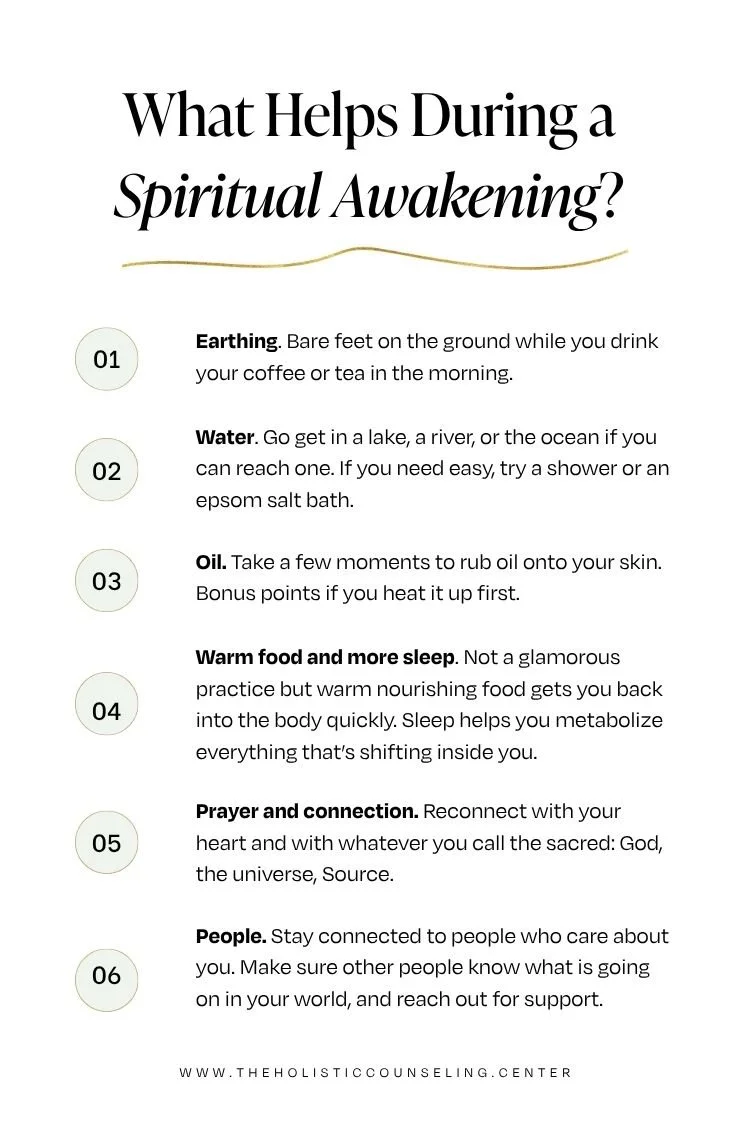
Earthing. Bare feet on the ground while you drink your coffee or tea in the morning. It is the world’s most simple practice and it’s amazing to feel how quickly it can impact your entire system. Go lie down on the ground, get outside, or look out the window if that’s all you’ve got right now.
Water. Go get in a lake, a river, or the ocean if you can reach one. If you need easy, try a shower or an epsom salt bath.
Oil. Take a few moments to rub oil onto your skin. Bonus points if you heat it up first. It’s not only soothing, but it sends a signal of safety to your nervous system and can help you soothe the heightened energy moving through your body.
Warm food and more sleep. Not a glamorous practice but warm nourishing food gets you back into the body quickly. Sleep helps you metabolize everything that’s shifting inside you.
Prayer and connection. Reconnect with your heart and with whatever you call the sacred: God, the universe, Source. This is where I part ways with most of what you will read about spiritual support. The instruction is not to go deeper in. It is to reach out, and to let yourself be held by something larger than you.
People. Stay connected to people who care about you. Make sure other people know what is going on in your world, and reach out for support. Who else knows what is going on? Can someone come and be with you when things are feeling intense?
None of us are meant to navigate an awakening alone. And none of these practices are about making the experience stop. They are about helping you stabilize, calibrate and expand your capacity for holding the experience.
Therapy for a Spiritual Awakening: How We Can Help
Grounding practices are good medicine, but they are not a substitute for professional support.
If you are overwhelmed, unmoored, feeling all the feels and looking for a therapist to walk through it with you, I’m glad you’re here.
Here at The Holistic Counseling Center, our licensed and associate therapists are clinically trained and spiritually informed. We believe healing means treating the whole person, mind, body, heart and spirit. We believe your symptoms are sacred and are committed to helping people just like you, integrate and heal, not just relieve symptoms.
We treat anxiety, trauma, depression as well as spiritual awakening, dark night of the soul, and existential crisis.
We weave traditional psychotherapy modalities like CBT and EMDR together with depth therapy, IFS therapy, somatic therapy, nervous system regulation, and transpersonal or spiritual therapy. In practice that means we can help steady your body while we make sense of what your soul is doing, at the same time, in the same room.
No matter what you’re going through, there is nothing about you or your experience that is too much, too messy, or too far out. We see you, we honor you, and we will walk through it with you.
We are accepting new clients and would love to support you. We offer in-person therapy in El Dorado Hills, San Anselmo, and San Francisco, and online throughout California.
Taking the first step is simple:
Schedule a Free Consultation Call: We’ll learn more about what’s happening in your life and answer your questions.
Get Matched With a Therapist: We’ll match you with a therapist who feels like a fit, and you can speak with them before your first session if you like.
Begin Your Journey: Have your first session and start learning how to hold what is opening in you.
Wishing you well on your healing journey.
— Kim Burris, LMFT
Takeaway
A spiritual awakening is a radical shift in consciousness, usually accompanied by intense physical sensations, where your sense of who you are, and how you fit into the world, changes. It typically lands in the body first, as energy and a heightened sensitivity to everything around you, and then in the heart, as grief for who you were, sharper intuition, and the knowing that you can never go back. It’s wildly inconvenient, even when it’s beautiful, and you don’t have to navigate it alone. Reach out to get matched with one of our holistic therapists today.
Additional Resources
For those interested in exploring the spiritual side of mental health, here are some additional resources:
Spiritual Therapy and the Benefits of Working with a Spiritual Therapist
Book Recommendations from a Holistic Psychotherapist (Free Guide)
References
Cortright, B. (1997). Psychotherapy and spirit: Theory and practice in transpersonal psychotherapy. State University of New York Press.
Grof, C., & Grof, S. (2017). Spiritual emergency: The understanding and treatment of transpersonal crises. International Journal of Transpersonal Studies, 36(2), 30–43. https://doi.org/10.24972/ijts.2017.36.2.30
Lindahl, J. R., Fisher, N. E., Cooper, D. J., Rosen, R. K., & Britton, W. B. (2017). The varieties of contemplative experience: A mixed-methods study of meditation-related challenges in Western Buddhists. PLOS ONE, 12(5), e0176239. https://doi.org/10.1371/journal.pone.0176239
About the author
Kim Burris, LMFT, is a licensed holistic psychotherapist, founder of The Holistic Counseling Center, and author of The First 90 Days After Birth. Her work has been featured in Vogue, Bustle, and the Daily OM.
She honors the mind-body-spirit connection and offers evidence-based psychotherapy with a heart-centered approach that helps people find relief from anxiety and self-sabotage so they can live life with more joy, freedom, and ease.
Kim and her team currently offer holistic counseling in El Dorado Hills, San Anselmo, and San Francisco, and online throughout California.
Click here to book a no-cost consultation call and get matched with one of our holistic therapists.

Looking for your next favorite book?

Disclaimer: This content is for informational purposes only and is not intended to be a substitute for professional medical advice, diagnosis, or treatment. Always seek the advice of your physician or qualified mental health professional.